Environment: milieu / climate zone / rango de profundidad / distribution range
Ecología
marino asociado a arrecife; rango de profundidad 2 - 50 m (Ref. 9680), usually 3 - 20 m (Ref. 40849). Subtropical; 35°N - 31°S, 180°W - 180°E (Ref. 55213)
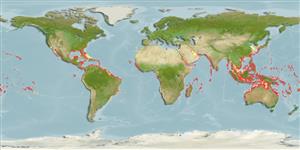
Circumtropical. Eastern Pacific: San Diego, California, USA to Chile, including the Galapagos Islands (Ref. 37955). Western Atlantic: Bermuda, Massachusetts (USA), and northern Gulf of Mexico to Brazil (Ref. 7251). Eastern Atlantic: 30°N to 23°S (Ref. 6951). Western Indian Ocean: Red Sea to Madagascar, Reunion and Mauritius (Ref. 33390). The reports in the Mediterranean Sea are doubtful (Ref. 50345).
Tamaño / Peso / Age
Madurez: Lm ? range ? - ? cm
Max length : 91.0 cm TL macho / no sexado; (Ref. 2850); common length : 40.0 cm TL macho / no sexado; (Ref. 26999); peso máximo publicado: 2.8 kg (Ref. 40637)
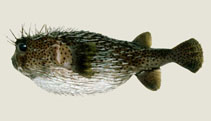
Espinas dorsales (total) : 0; Radios blandos dorsales (total) : 14 - 17; Espinas anales: 0; Radios blandos anales: 14 - 16. Body robust; teeth united in each jaw but without a central division; body covered with long, sharp spines, folded backwards when body not inflated; 16 to 20 spines between snout and dorsal fin; dorsal region of caudal peduncle spiny; back, flanks and fins light brown with numerous dark spots; belly spiny (Ref. 55763). Spines long. Body grayish tan, with small black spots, but no large dark blotches. Belly white, surrounded by dusky ring (Ref. 26938). About 20 spines in an approximate row between snout and dorsal fin (Ref. 13442).
Body shape (shape guide): short and / or deep.
Occur in lagoon and seaward reefs to at least 50 m. Commonly seen in caves and holes in shallow reefs (Ref. 26938, 48637). Juveniles to about 20 cm are pelagic. Adults benthic (Ref. 30573). Solitary and nocturnal that feed on hard shelled invertebrates like sea urchins, gastropods, and hermit crabs (Ref. 9680). Generally common (Ref. 9710). Not normally used as food (Ref. 3717). Reached a life-span of 10 years and a length of 69 cm in the McGinty Aquarium (E. Dashiell, pers. comm 2004), suggesting a preliminary K=0.12.
Life cycle and mating behavior
Madurez | Reproducción | Puesta | Huevos | Fecundidad | Larva
Randall, J.E., G.R. Allen and R.C. Steene, 1990. Fishes of the Great Barrier Reef and Coral Sea. University of Hawaii Press, Honolulu, Hawaii. 506 p. (Ref. 2334)
IUCN Red List Status (Ref. 130435: Version 2025-1)
Threat to humans
Poisonous to eat (Ref. 4690)
Human uses
Pesquerías: escaso valor comercial; pesca deportiva: si; Acuario: Comercial
Herramientas
Special reports
Download XML
Fuentes de Internet
Estimates based on models
Preferred temperature (Referencia
123201): 23.3 - 29, mean 27.4 °C (based on 1822 cells).
Phylogenetic diversity index (Referencia
82804): PD
50 = 0.5313 [Uniqueness, from 0.5 = low to 2.0 = high].
Bayesian length-weight: a=0.08710 (0.04231 - 0.17931), b=2.77 (2.58 - 2.96), in cm total length, based on LWR estimates for this species & (Sub)family-body (Ref.
93245).
Nivel trófico (Referencia
69278): 3.7 ±0.0 se; based on diet studies.
Resiliencia (Referencia
120179): Bajo, población duplicada en un tiempo mínimo de 4.5-14 años (tmax>10; preliminary K=0.12).
Fishing Vulnerability (Ref.
59153): High vulnerability (56 of 100).
🛈
Nutrients (Ref.
124155): Calcium = 16 [6, 54] mg/100g; Iron = 0.538 [0.255, 1.321] mg/100g; Protein = 19.4 [17.2, 21.6] %; Omega3 = 0.153 [0.078, 0.295] g/100g; Selenium = 23.5 [9.7, 53.9] μg/100g; VitaminA = 15.6 [3.8, 69.9] μg/100g; Zinc = 0.52 [0.33, 0.84] mg/100g (wet weight);