>
Eupercaria/misc (Various families in series Eupercaria) >
Sciaenidae (Drums or croakers)
Etymology: Pseudotolithus: Greek, pseudes = false + greek, otos = ear + Greek, lithos = stone (Ref. 45335).
More on author: Bleeker.
Environment: milieu / climate zone / distribuzione batimetrica / distribution range
Ecologia
marino; acqua dolce; salmastro demersale; distribuzione batimetrica 0 - 160 m (Ref. 3593). Tropical; 12°N - 17°S
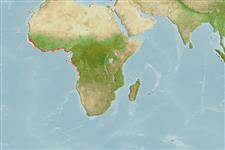
Eastern Atlantic: Guinea-Bissau (Ref. 26999) to southern Angola (Ref. 3593, 81656). Possibly also occurring more to the north (Ref. 81656).
Size / Peso / Age
Maturità: Lm ? range ? - ? cm
Max length : 60.0 cm TL maschio/sesso non determinato; (Ref. 3593); common length : 35.0 cm TL maschio/sesso non determinato; (Ref. 3593)
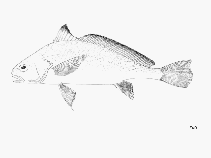
Spine dorsali (totale) : 10; Raggi dorsali molli (totale) : 35 - 39; Spine anali: 2; Raggi anali molli: 7. Diagnosis: moderately sized species with an elongate and laterally compressed body; dorsal with 9 (10?) spines in 1st part, second part with 1 spine and 35-39 soft fin rays; second anal spine clearly shorter than first anal fin soft ray, i.e. about half its length, and robust; pectoral fins long, 23.3-27.3% SL; caudal fin S-shaped; mouth inferior almost horizontal; maxilla extending to posterior half of eye; 7-9/1/4-7 (total 13-18) gill rakers on 1st gill arch; lower part of 1st gill arch with 2-6 reduced additional gill rakers, upper part with 0-2 reduced additional ones; gill rakers moderately long and fine, but shorter than the gill filament at angle between lower and upper part of gill arch; preopercular edge feebly denticulated but never with spines; eyes rather small, 4.6-5.4 times in HL, but this character is difficult to use for identification because of allometry (Ref. 81656).
Coloration: generally very dark, but occasionally pale silver often with faint dark brown oblique lines on sides; ventral side of head and belly yellowish; all fins greyish to very dark brown, black (Ref. 81656).
Body shape (shape guide): elongated; Cross section: compressed.
Occurs in coastal waters from the shore to about 70 m over mud bottom, but moves to deeper water. Also found in estuaries and coastal lagoons (Ref. 3593, 81656). Mainly feeds on benthic invertebrates (Ref. 81656).
Life cycle and mating behavior
Maturità | Riproduzione | Deposizione | Uova | Fecundity | Larve
Chao, L.N. and E. Trewavas, 1990. Sciaenidae. p. 813-826. In J.C. Quero, J.C. Hureau, C. Karrer, A. Post and L. Saldanha (eds.) Check-list of the fishes the eastern tropical Atlantic (CLOFETA). JNICT, Lisbon; SEI, Paris; and UNESCO, Paris. Vol. 2. (Ref. 3593)
IUCN Red List Status (Ref. 130435: Version 2025-1)
Threat to humans
Harmless
Human uses
Pesca: commerciale
Strumenti
Special reports
Download XML
Fonti Internet
Estimates based on models
Preferred temperature (Fonte Biblio.
123201): 19.2 - 27.9, mean 26 °C (based on 102 cells).
Phylogenetic diversity index (Fonte Biblio.
82804): PD
50 = 0.5156 [Uniqueness, from 0.5 = low to 2.0 = high].
Bayesian length-weight: a=0.00575 (0.00280 - 0.01185), b=3.12 (2.95 - 3.29), in cm total length, based on LWR estimates for this (Sub)family-body shape (Ref.
93245).
Trophic level (Fonte Biblio.
69278): 3.6 ±0.6 se; based on size and trophs of closest relatives
Resilienza (Fonte Biblio.
120179): Medio, tempo minimo di raddoppiamento della popolazione 1.4 - 4.4 anni (Preliminary K or Fecundity.).
Fishing Vulnerability (Ref.
59153): Moderate vulnerability (44 of 100).
🛈
Nutrients (Ref.
124155): Calcium = 114 [62, 210] mg/100g; Iron = 0.872 [0.469, 1.499] mg/100g; Protein = 18.7 [17.5, 19.8] %; Omega3 = 0.156 [0.078, 0.287] g/100g; Selenium = 75.1 [39.5, 144.8] μg/100g; VitaminA = 15.5 [6.1, 43.4] μg/100g; Zinc = 1.15 [0.82, 1.64] mg/100g (wet weight);