



Sube tu fotos y Vídeos
Imágenes | Vídeos | Sellos, monedas, varios | Google image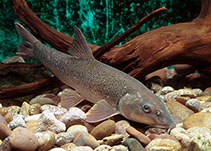 Barbus barbus
Foto de Muséum-Aquarium de Nancy/D. Terver
Imágenes | Vídeos | Sellos, monedas, varios | Google image
Foto de Muséum-Aquarium de Nancy/D. Terver
Clasificación / Nombres Nombres comunes | Sinónimos | Catalog of Fishes(Género, Especie) | ITIS | CoL | WoRMS | Cloffa
> Cypriniformes (Carps) > Cyprinidae (Minnows or carps) > Barbinae
Etymology: Barbus: Latin, barbus = barbel (Ref. 45335).
Eponymy: Sir Charles Alfred Payton (1843–1926) was a British adventurer, writer, fisherman and diplomat who was British Consul to Morocco, where this barb is found. [...] (Ref. 128868), visit book page.
More on author: Linnaeus.
Etymology: Barbus: Latin, barbus = barbel (Ref. 45335).
Eponymy: Sir Charles Alfred Payton (1843–1926) was a British adventurer, writer, fisherman and diplomat who was British Consul to Morocco, where this barb is found. [...] (Ref. 128868), visit book page.
More on author: Linnaeus.
Entorno: milieu / zona climática / rango de profundidad / gama de distribución Ecología
; agua dulce bentopelágico; potamodromo (Ref. 51243); rango de profundidad 10 - ? m. Temperate; 10°C - 24°C (Ref. 2060); 57°N - 42°N, 5°W - 36°E
Distribución Territorios | Áreas FAO | Ecosistemas | Ocurrencias, apariciones | Mapa de puntos | Introducciones | Faunafri
Europe: North of the Pyrénées and Alps, from Adour (France) eastward to Neman (Lithuania, Russia) drainages, in rivers draining to Atlantic, North sea and southern Baltic Sea; Danube to Dniepr drainages in northern Black Sea basin; southeastern England north to Yorkshire. Found almost throughout Mediterranean drainages of France. Locally introduced in northern and central Italy, rivers Wear, Tees and Medway and most western drainages of England.
Tamaño / Peso / Edad
Madurez: Lm ? range ? - ? cm
Max length : 120 cm TL macho / no sexado; (Ref. 31730); common length : 30.0 cm TL macho / no sexado; (Ref. 556); peso máximo publicado: 12.0 kg (Ref. 31730); edad máxima reportada: 15 años (Ref. 59043)
Max length : 120 cm TL macho / no sexado; (Ref. 31730); common length : 30.0 cm TL macho / no sexado; (Ref. 556); peso máximo publicado: 12.0 kg (Ref. 31730); edad máxima reportada: 15 años (Ref. 59043)
Descripción breve Claves de identificación | Morfología | Morfometría
Espinas dorsales (total) : 3 - 4; Radios blandos dorsales (total) : 7 - 9; Espinas anales: 2 - 3; Radios blandos anales: 5 - 6; Vértebra: 46 - 47. Diagnosed from its congeners in France, Great Britain, Black, North, Baltic and Adriatic Sea basins and Apennine Peninsula by having the following characters: lower lip thick with a median swollen pad; tip of dorsal pointed; posterior margin of dorsal concave; last simple dorsal ray spinous, serrated along entire posterior edge; flexible segmented part of last simple dorsal ray about 20-24% of its length; fine dark spots (or no spots) in individuals larger than 10 cm SL; 53-63 total scales on lateral line; 12-14 scale rows between dorsal origin and lateral line; pelvic origin about below dorsal origin; scales with free posterior part pointed; scales on back with 1-5 well developed median longitudinal epithelial crests (Ref. 59043). Caudal fin with 19-20 rays (Ref. 2196).
Body shape (shape guide): fusiform / normal.
Body shape (shape guide): fusiform / normal.
Inhabits from premontane to lowland reaches of clear, warm, medium sized to large rivers with fast current and gravel bottom. Occasionally found in lakes. Frequently overwinters in large group, inactive or active in slow-flowing river habitats. Adults often form shoal, hiding under overhanging trees or bridges during the day. Adults are encountered most active during dusk and dawn while larvae and juveniles are active during both day and night. Larvae and juvenile stay on the bottom in very shallow shoreline habitats and leave the shores for faster-flowing waters as they grow (Ref. 59043). Lives in the deeper, faster-flowing upper reaches of rivers with stony or gravel bottom (barbel zones). Feeds chiefly on benthic invertebrates, such as small crustaceans, insect larvae, mollusks, mayfly and midge larvae (Ref. 6258) and also on small fish and sometimes algae (Ref. 59043). Spawns usually in very shallow, fast-flowing riffles (Ref. 59043). Spawning occurs from May to July after the fish have migrated upriver (Ref. 556). Eggs are poisonous (Refs. 4537, 6258). Locally threatened due to water pollution and river regulation, especially in Baltic drainages, Elbe, South Bug and Dniepr, and heavily impacted by pollution in central Europe but recovering. Population has declined sharply due to construction of large reservoirs and pollution during 20th century and has stabilized at a moderate level since then (Ref. 59043).
Ciclo vital y comportamiento de apareamiento Madurez | Reproducción | Puesta | Huevos | Fecundidad | Larva
"Individual females spawn with several males. Males assemble at spawning grounds and follow ripe females, often with much splashing, to shallow riffles. Males may exhibit courting or sneaking tactics in spawning site. Courting males follow females to spawning site and, during the spawning act, one male swims head to head with the female. Sneaking males, waiting in the spawning site, then join the couple and try to fertilize eggs. Up to 130 males have been reported to be involved in a single spawning act. Females deposit non-sticky eggs in 2-3 portions into excavations made in the gravel" (Ref. 59043).
Referencia principal
Suba sus referencias | Referencias | Coordinador | Colaboradores
Bianco, P.G., 1998. Diversity of Barbinae fishes in southern Europe with description of a new genus and a new species (Cyprinidae). Ital. J. Zool. 65:125-136. (Ref. 31730)
Situación en la Lista Roja de la UICN (Ref. 130435: Version 2025-2 (Global))
Least Concern (LC) ; Date assessed: 12 November 2022
CITES
Not Evaluated
Amenaza para el ser humano
Other (Ref. 4537)
Usos humanos
Pesquerías: escaso valor comercial; Acuicultura: posible uso futuro; pesca deportiva: si; Acuario: Comercial
FAO - Sistemas de acuicultura: producción; pesquerías: desembarques; Publication: search | FishSource |
Más información
Ecología Trófica
Alimentos (presas)
Composición de la dieta
consumo de alimento
Raciones de comida
Despredadores
Alimentos (presas)
Composición de la dieta
consumo de alimento
Raciones de comida
Despredadores
Dinámica de la población
Coeficiente del crecimiento para
Edades / tallas máximas
Longitud-peso rel.
Longitud-longitud rel.
Longitud-frecuencias
Conversión de masas
Reclutamiento
Abundancia
Coeficiente del crecimiento para
Edades / tallas máximas
Longitud-peso rel.
Longitud-longitud rel.
Longitud-frecuencias
Conversión de masas
Reclutamiento
Abundancia
Ciclo de vida
Reproducción
Madurez
Madurez/Gills rel.
Fecundidad
Puesta
Agregaciones de desove
Huevos
Desarrollo de los huevos
Larva
Dinámica larvaria
Reproducción
Madurez
Madurez/Gills rel.
Fecundidad
Puesta
Agregaciones de desove
Huevos
Desarrollo de los huevos
Larva
Dinámica larvaria
Distribución
Territorios
Áreas FAO
Ecosistemas
Ocurrencias, apariciones
Introducciones
BRUVS - Vídeos
Territorios
Áreas FAO
Ecosistemas
Ocurrencias, apariciones
Introducciones
BRUVS - Vídeos
Anatomía
Superficie branquial
Cerebro
Otolito
Superficie branquial
Cerebro
Otolito
Fisiología
Composición corporal
Nutrientes
Consumo del oxígeno
Tipo de natación
Velocidad de natación
Pigmentos visuales
Sonido de peces
Enfermedades y parásitos
Toxicidad (CL50)
Composición corporal
Nutrientes
Consumo del oxígeno
Tipo de natación
Velocidad de natación
Pigmentos visuales
Sonido de peces
Enfermedades y parásitos
Toxicidad (CL50)
Relacionados con el ser humano
Sistemas de acuicultura
Perfiles de acuicultura
Razas
Ciguatera cases
Sellos, monedas, varios
Sistemas de acuicultura
Perfiles de acuicultura
Razas
Ciguatera cases
Sellos, monedas, varios
Herramientas
Cuestionario orgánico | Libro electrónico | Guía de campo | Claves de identificación | Asistente para frecuencias de tallas | Herramienta de ciclo de vida | Mapa de puntos |
Catch-MSY |
Informes especiales
Comprobar el mantenimiento del acuario | Buscar fichas sobre especies | Consulte las hojas informativas sobre acuicultura
Descargar XML
Fuentes de Internet
AFORO (otoliths) | Alien/Invasive Species database | Aquatic Commons | BHL | Cloffa | Websites from users | Check FishWatcher | CISTI | Catalog of Fishes: Género, Especie | DiscoverLife | DORIS | ECOTOX | FAO - Sistemas de acuicultura: producción; pesquerías: desembarques; Publication: search | Faunafri | Fishipedia | Fishtrace | GloBI | Google Books | Google Scholar | Google | IGFA World Record | Bases de datos nacionales | OneZoom | Open Tree of Life | Otolith Atlas of Taiwan Fishes | Acuarios públicos | PubMed | Reef Life Survey | Socotra Atlas | TreeBase | Árbol de la vida | Wikipedia: Go, búsqueda | World Records Freshwater Fishing | Expediente Zoológico
Estimaciones basadas en modelos
Índice de diversidad filogenética (Referencia 82804): PD50 = 0.5000 [Uniqueness, from 0.5 = low to 2.0 = high].
Bayesian length-weight: a=0.00912 (0.00677 - 0.01229), b=2.98 (2.94 - 3.02), in cm total length, based on LWR estimates for this species (Ref. 93245).
Nivel trófico (Referencia 69278): 3.1 ±0.39 se; based on food items.
Resiliencia (Referencia 120179): Bajo, población duplicada en un tiempo mínimo de 4.5-14 años (tm=3-5).
Nutrientes (Ref. 124155): Calcium = 23.2 [13.3, 39.6] mg/100g; Iron = 0.391 [0.246, 0.620] mg/100g; Protein = 17.7 [16.8, 18.6] %; Omega3 = 0.972 [0.401, 2.502] g/100g; Selenium = 20.4 [7.7, 54.2] μg/100g; VitaminA = 33.1 [10.4, 106.8] μg/100g; Zinc = 0.811 [0.568, 1.154] mg/100g (wet weight);