>
Gobiiformes (Gobies) >
Gobiidae (Gobies) > Gobiinae
Etymology: Stonogobiops: Greek, stonos, -ou = groan + Latin, gobius = gudgeon + Greek, ops = appearance (Ref. 45335).
More on authors: Hoese & Randall.
Environment: milieu / Klimaatzone / Diepte / distribution range
Ecologie
marien rifbewoner, usually 15 - 25 m (Ref. 27115). Tropical; 22°C - 25°C (Ref. 27115); 15°N -
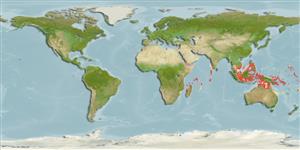
Indo-West Pacific: Seychelles, the Philippines, and Bali, Indonesia.
Grootte / Gewicht / Leeftijd
Maturiteit: Lm ? range ? - ? cm
Max length : 6.0 cm SL mannelijk / geslacht onbekend; (Ref. 48637)
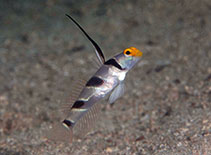
Dorsale stekels (totaal) : 7; Dorsale zachte stralen (totaal) : 12; Anale stekels: 1; Anale zachte stralen: 11; Wervels: 26. Bright yellow from top of head to chin including most of iris; 2nd dorsal fin and caudal fin translucent yellow, both with diffuse light blue submarginal band and 4-5 rows of elliptical dark-edged blue spots; anal and pointed pectoral fins with yellowish rays. Naked thorax and pectoral base. Head pores absent. Dark head band ending on lower margin of preoperculum. Median predorsal region naked. Eye and mouth large. Angle of jaws 25 degrees. Longitudinal scale series 84, transverse 21. 1st 2 elongated spines and its membrane black.
Body shape (shape guide): elongated; Cross section: compressed.
Occurs in pairs and live symbiotically with Alpheus randalli. The pair hover above the burrow's entrance on dark sandy bottoms. Inhabits deep coastal slopes and sand flats, usually in depth over 10 meters (Ref. 48637). Also found in sand-rubble bottoms (Ref 90102).
Levenscyclus en paargedrag
Maturiteit | Voortplanting | Paaien | Eieren | Fecunditeit | Larven
Hoese, D.F. and J.E. Randall, 1982. Revision of the Indo-Pacific gobiid fish genus Stonogobiops. Indo-Pac. Fish. (1):18 p. (Ref. 397)
Status op de Rode Lijst van het IUCN (Ref. 130435: Version 2025-1)
Gevaar voor de mens
Harmless
Gebruik door de mens
Visserij: commercieel; Aquarium: Commercieel
Tools
Speciale rapporten
Download XML
Internetbronnen
Estimates based on models
Preferred temperature (Ref.
123201): 27.5 - 29, mean 28.4 °C (based on 160 cells).
Fylogenetische diversiteitsindex (Ref.
82804): PD
50 = 0.5078 [Uniqueness, from 0.5 = low to 2.0 = high].
Bayesian length-weight: a=0.00724 (0.00339 - 0.01546), b=3.10 (2.92 - 3.28), in cm total length, based on LWR estimates for this (Sub)family-body shape (Ref.
93245).
Trofisch niveau (Ref.
69278): 3.3 ±0.3 se; based on size and trophs of closest relatives
Weerstandsvermogen (Ref.
120179): Hoog, minimale populatieverdubbelingstijd minder dan 15 maanden (Preliminary K or Fecundity.).
Fishing Vulnerability (Ref.
59153): Low vulnerability (10 of 100).
🛈