Randallichthys filamentosus, Randall's snapper : fisheries

You can sponsor this page

Randallichthys filamentosus (Fourmanoir, 1970)

Randall's snapper
Add your observation in Fish Watcher
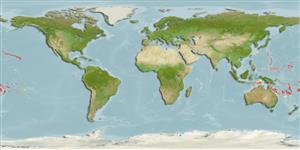
Native range | All suitable habitat | Point map | Year 2050
This map was computer-generated and has not yet been reviewed.
Randallichthys filamentosus   AquaMaps   Data sources: GBIF OBIS
Upload your photos and videos
Bilder | Google image
Image of Randallichthys filamentosus (Randall\
Randallichthys filamentosus
Picture by Randall, J.E.


Japan country information

Common names: Bake-akamutsu
Occurrence: native
Salinity: marine
Abundance: | Ref:
Importance: commercial | Ref:
Aquaculture: | Ref:
Regulations: | Ref:
Uses: no uses
Comments: Occurs in the Ryukyu Islands. Also Ref. 55. Utilized as a food fish but large specimens are oily.
National Checklist:
Country Information: https://www.cia.gov/library/publications/resources/the-world-factbook/geos/ja.html
National Fisheries Authority: http://www.maff.go.jp/eindex.html
Occurrences: Occurrences Point map
Main Ref: Masuda, H., K. Amaoka, C. Araga, T. Uyeno and T. Yoshino, 1984
National Database:

Common names from other countries

Classification / Names Populärnamn | synonymer | Catalog of Fishes(Släkte, Arter) | ITIS | CoL | WoRMS | Cloffa

> Eupercaria/misc (Various families in series Eupercaria) > Lutjanidae (Snappers) > Etelinae
Etymology: Randallichthys: After John Randall, marine biologist, Bishop Museum of Hawaii; he worked in systematic ichthyology with fishes of Indopacific region + Greek, ichthys = fish.
Eponymy: Dr John ‘Jack’ Ernest Randall Jr. [...] (Ref. 128868), visit book page.

Environment: milieu / climate zone / djupintervall / distribution range Ekologi

marina bentopelagisk; djupintervall 150 - 300 m (Ref. 55). Deep-water; 35°N - 24°S, 121°E - 147°W (Ref. 55)

Utbredning Länder | FAO områden | Ekosystem | Förekomster | Prickkarta | Utplanteringar | Faunafri

Pacific Ocean: known only from the Hawaiian Islands, Cook Islands, New Caledonia, and Okinawa, Japan but probably widespread in the area. Recently recorded from Tonga (Ref. 53797). Eastern Indian Ocean: Scott Reefs, northwestern Australia (Ref. 82665).

Size / Vikt / Age

Könsmognad: Lm ?  range ? - ? cm
Max length : 50.0 cm SL hane/ej könsbestämd; (Ref. 9821); common length : 40.0 cm SL hane/ej könsbestämd; (Ref. 9821)

Short description Bestämningsnycklar | Morfologi | Morfometri

Taggstrålar i ryggfenan (totalt) : 10; Mjukstrålar i ryggfenan (totalt) : 12; Taggstrålar i analfenan: 3; Mjukstrålar i analfenan: 9. Head blunt. Interorbital space flat. Eye large. Preorbital bone relatively narrow. Snout short. Lower jaw protruding. Pectoral fins short, not reaching level of anus. Lower lobe of caudal fin with some rays excessively produced and filamentous in young. Scale rows on back parallel to lateral line. Overall color rosy red with a yellowish tinge; the dorsal fin grayish, the outer edge of its spinous portion black; the outer edge of the pelvic fins also black.
Body shape (shape guide): fusiform / normal; Cross section: oval.

Biologi     Ordlista (t.ex. epibenthic)

Adults are found on rocky bottoms in relatively deep water (Ref. 55). Marketed fresh (Ref. 55).

Life cycle and mating behavior Könsmognad | Reproduktion | Lek | Ägg | Fecundity | Larver

Main reference Upload your references | referenser | Koordinator | Medarbetare

Allen, G.R., 1985. FAO Species Catalogue. Vol. 6. Snappers of the world. An annotated and illustrated catalogue of lutjanid species known to date. FAO Fish. Synop. 125(6):208 p. Rome: FAO. (Ref. 55)

IUCN Red List Status (Ref. 130435: Version 2025-1)

  Least Concern (LC) ; Date assessed: 05 March 2015

CITES

Not Evaluated

CMS (Ref. 116361)

Not Evaluated

Threat to humans

  Harmless


Human uses

Fiskeri: mindre kommeriell
FAO - Publication: search | FishSource |

Ytterligare information

Trophic ecology
Food items (preys)
Födosammansättning
Födointag
Food rations
Predatorer
Ekologi
Ekologi
Home ranges
Population dynamics
Tillväxtparametrar
Max. ages / sizes
Length-weight rel.
Length-length rel.
Length-frequencies
Mass conversion
Rekrytering
Abundans
Life cycle
Reproduktion
Könsmognad
Maturity/Gills rel.
Fecundity
Lek
Spawning aggregations
Ägg
Egg development
Larver
Larvdynamik
Utbredning
Länder
FAO områden
Ekosystem
Förekomster
Utplanteringar
BRUVS - Videos
Anatomy
Gälyta
Brain
Otolith
Physiology
Body composition
Nutrients
Syreförbrukning
Swimming type
Simhastighet
Visual pigments
Fish sound
Diseases & Parasites
Toxicity (LC50s)
Genetik
Genome
Genetik
Heterozygosity
Ärftlighet
Human related
Aquaculture systems
Vattenbruksprofiler
Avelslinjer
Ciguatera cases
Stamps, coins, misc.
Outreach
Medarbetare
referenser
referenser

Verktyg

Special reports

Download XML

Internet-källor

AFORO (otoliths) | Aquatic Commons | BHL | Cloffa | Websites from users | Check FishWatcher | CISTI | Catalog of Fishes: Släkte, Arter | DiscoverLife | ECOTOX | FAO - Publication: search | Faunafri | Fishipedia | Fishtrace | GloBI | Google Books | Google Scholar | Google | IGFA World Record | OneZoom | Open Tree of Life | Otolith Atlas of Taiwan Fishes | PubMed | Reef Life Survey | Socotra Atlas | TreeBase | Tree of Life | Wikipedia: Go, sök | Zoological Record

Estimates based on models

Preferred temperature (Ref. 123201): 13.3 - 23.4, mean 19.3 °C (based on 11 cells).
Phylogenetic diversity index (Ref. 82804):  PD50 = 1.0000   [Uniqueness, from 0.5 = low to 2.0 = high].
Bayesian length-weight: a=0.01549 (0.00709 - 0.03381), b=2.95 (2.77 - 3.13), in cm total length, based on LWR estimates for this (Sub)family-body shape (Ref. 93245).
Trofisk nivå (Ref. 69278):  4.0   ±0.4 se; based on size and trophs of closest relatives
Resiliens (Ref. 120179):  Mellan, lägsta populationsfördubblingstid 1,4-4,4 år (Preliminary K or Fecundity.).
Fishing Vulnerability (Ref. 59153):  Moderate vulnerability (44 of 100). 🛈
Price category (Ref. 80766):   Very high.