Teleostei (teleosts) >
Aulopiformes (Grinners) >
Synodontidae (Lizardfishes) > Synodontinae
Etymology: Synodus: Greek, syn, symphysis = grown together + Greek, odous = teeth (Ref. 45335).
More on authors: Spix & Agassiz.
Environment: milieu / climate zone / depth range / distribution range
Ecology
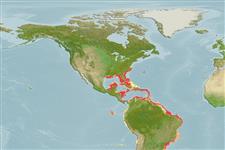
Marine; reef-associated; depth range 3 - 320 m (Ref. 9710), usually ? - 60 m (Ref. 93218). Subtropical; 37°N - 30°S, 95°W - 34°W
Western Atlantic: Bermuda, North Carolina (USA) and northern Gulf of Mexico to Santa Catarina, Brazil (Ref. 57756). Most common lizard fish in the West Indies (Ref. 13442).
Size / Weight / Age
Maturity: Lm ? range ? - ? cm
Max length : 46.0 cm TL male/unsexed; (Ref. 26340); common length : 40.0 cm TL male/unsexed; (Ref. 5217); max. published weight: 1.0 kg (Ref. 5217)
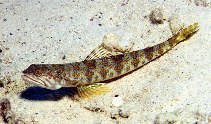
Dorsal spines (total): 0; Dorsal soft rays (total): 11 - 12; Anal spines: 0; Anal soft rays: 11; Vertebrae: 49 - 52. This species is distinguished by the following characters: D rays 11-12; A rays 11; total caudal rays 40-42; dorsal segmented caudal rays 9; ventral segmented caudal rays 9-10; dorsal procurrent caudal rays 11-12; ventral procurrent caudal rays 9-10; pelvic-fin rays 8; pectoral-fin rays 11-13; total vertebrae 49-52 (modally 50); pored lateral-line scales 49-52 (modally 51); median predorsal scales 16-17; scale rows on cheek 6-8; HL 15.2-28.4% SL (26.6%); orbit diameter 3.6-6.4% SL (4.7%) and 13.4-22.5% HL (17.2%); interorbital width 2.8-5.3% SL (4.3%) and 10.1-19.4% HL (15.9%); flap on anterior nostril is small and broad, its length 1.5-3.6% HL (2.4%); snout triangular in dorsal view; pelvic-fin length 23.1-26.7% SL (24.9%); when preserved, 3-6 dark bars on caudal fin spanning upper and lower lobes; with a small, rectangular-shaped, black scapular blotch (length 5.1-12.2% HL, mean 8.4%); there are 9-13 dark bars on trunk; colour in life, adults tan to olive and with unevenly distributed yellow stripes along body (Ref. 93218).
Body shape (shape guide): elongated; Cross section: circular.
Found on the sandy bottom around boulders or in sandy corridors in patch reefs (Ref. 5521). Uncommon near the shore.
Life cycle and mating behavior
Maturity | Reproduction | Spawning | Eggs | Fecundity | Larvae
Robins, C.R. and G.C. Ray, 1986. A field guide to Atlantic coast fishes of North America. Houghton Mifflin Company, Boston, U.S.A. 354 p. (Ref. 7251)
IUCN Red List Status (Ref. 130435: Version 2025-2)
Threat to humans
Harmless
Human uses
Fisheries: minor commercial; gamefish: yes; aquarium: commercial
Tools
Special reports
Download XML
Internet sources