Teleostei (teleosts) >
Pleuronectiformes (Flatfishes) >
Paralichthyidae (Large-tooth flounders)
Etymology: Paralichthys: Greek, para = the side of + Greek, ichthys = fish + Greek, suffix, oides = similar to (Ref. 45335).
More on author: Ginsburg.
Environment: milieu / climate zone / depth range / distribution range
Ecology
Marine; demersal; depth range 0 - 185 m (Ref. 5217). Tropical
Western Central Atlantic: Colombia and Venezuela to Trinidad and Tobago. Reported to range south to Suriname (Ref. 13608).
Size / Weight / Age
Maturity: Lm ? range ? - ? cm
Max length : 50.0 cm TL male/unsexed; (Ref. 5217); common length : 40.0 cm TL male/unsexed; (Ref. 5217)
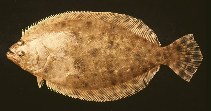
Dorsal soft rays (total): 69 - 80; Anal soft rays: 55 - 64. Head moderately pointed; brown with numerous roundish dark spots on head, body and fins, many as large or larger than eyes; also numerous small dark and small pale spots; teeth uniserial, the anterior ones enlarged; origin of dorsal fin above or slightly anterior to the front edge of eyes; caudal fin biconcave; pelvic fins short-based, symmetrically placed, and subequal (Ref. 13442).
Body shape (shape guide): short and / or deep.
Found over muddy and sandy bottoms. Marketed fresh.
Life cycle and mating behavior
Maturity | Reproduction | Spawning | Eggs | Fecundity | Larvae
Distinct pairing (Ref. 205).
Randall, J.E. and R. Vergara, 1978. Bothidae. In W. Fischer (ed.) FAO species identification sheets for fishery purposes. Western Central Atlantic (Fishing Area 31). FAO, Rome. Vol. 1. pag.var. (Ref. 3275)
IUCN Red List Status (Ref. 130435: Version 2025-2)
Threat to humans
Harmless
Human uses
Fisheries: minor commercial
Tools
Special reports
Download XML
Internet sources