Teleostei (teleosts) >
Ophidiiformes (Cusk eels) >
Bythitidae (Livebearing brotulas)
Etymology: Nybelinella: Because of Nybelin, a Swedish botanist, expert in fishes and fungus.
Eponymy: Orvar Nybelin (1892–1982) was a Swedish zoologist, marine biologist and ichthyologist. [...] John Eriksson was the surgeon aboard the Swedish ship ‘Albatross’ during its circumnavigation (1947–1948), during which the holotype was collected. He wrote: Deep Sea and Volcanic islands: A Naturalist’s Diary from Albatross Worldwide (1953). (Ref. 128868), visit book page.
Environment: milieu / climate zone / depth range / distribution range
Ecology
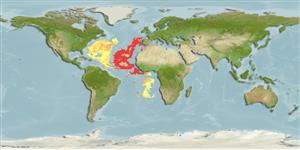
Marine; bathydemersal; depth range 4640 - 5440 m (Ref. 34024). Deep-water; 45°N - 27°S
Eastern Atlantic: between 42°38.5'N, 13°31'W and 42°42'N, 13°28'W (Ref. 7408), holotype from 1°03'N, 18°40'W. Western Atlantic: off the Bahamas.
Size / Weight / Age
Maturity: Lm ? range ? - ? cm
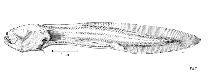
Max length : 8.0 cm TL male/unsexed; (Ref. 6527)
Rare species (Ref. 34024). Viviparous (Ref. 6527).
Life cycle and mating behavior
Maturity | Reproduction | Spawning | Eggs | Fecundity | Larvae
Nielsen, J.G., D.M. Cohen, D.F. Markle and C.R. Robins, 1999. Ophidiiform fishes of the world (Order Ophidiiformes). An annotated and illustrated catalogue of pearlfishes, cusk-eels, brotulas and other ophidiiform fishes known to date. FAO Fish. Synop. 125(18):178p. Rome: FAO. (Ref. 34024)
IUCN Red List Status (Ref. 130435: Version 2025-2)
Threat to humans
Harmless
Human uses
Fisheries: of no interest
Tools
Special reports
Download XML
Internet sources