Teleostei (teleosts) >
Ophidiiformes (Cusk eels) >
Ophidiidae (Cusk-eels) > Brotulotaeniinae
Etymology: Brotulotaenia: Latin, brotula, -ae = little, bud, shoot + Latin, taenia = stripe (Ref. 45335).
More on author: Cohen.
Environment: milieu / climate zone / depth range / distribution range
Ecology
Marine; bathypelagic; depth range 0 - 2650 m (Ref. 31173). Deep-water
Atlantic Ocean: Bermuda, Gulf of Mexico, Caribbean. Unusual occurrence from Flemish Cap bank. One record from northwest of Spain. Also known from the Indian Ocean (Ref. 34024).
Size / Weight / Age
Maturity: Lm ? range ? - ? cm
Max length : 32.0 cm SL male/unsexed; (Ref. 3686)
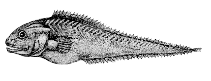
Dorsal spines (total): 0; Dorsal soft rays (total): 79 - 84; Anal spines: 0; Anal soft rays: 58 - 64; Vertebrae: 63 - 66. Scales small, non-imbricate prickles; opercle with no spine; median basibranchial tooth patch absent; gill rakers are tooth-bearing tubercles; otolith very small and rounded; precaudal vertebrae 12-15 (Ref. 34024). Head and body black (Ref. 31173).
Uncommon species (Ref. 34024). Reproductive strategy possibly similar to other members of this family featuring oviparity, with oval pelagic eggs floating in a gelatinous mass (Ref. 205).
Life cycle and mating behavior
Maturity | Reproduction | Spawning | Eggs | Fecundity | Larvae
Nielsen, J.G., D.M. Cohen, D.F. Markle and C.R. Robins, 1999. Ophidiiform fishes of the world (Order Ophidiiformes). An annotated and illustrated catalogue of pearlfishes, cusk-eels, brotulas and other ophidiiform fishes known to date. FAO Fish. Synop. 125(18):178p. Rome: FAO. (Ref. 34024)
IUCN Red List Status (Ref. 130435: Version 2025-2)
Threat to humans
Harmless
Human uses
Fisheries: of no interest
Tools
Special reports
Download XML
Internet sources