Teleostei (teleosts) >
Cichliformes (Cichlids, convict blennies) >
Cichlidae (Cichlids) > Pseudocrenilabrinae
Etymology: Neolamprologus: Greek, neos = new + Greek,lampros = torch + Greek, lagos = hare (Ref. 45335).
More on author: Boulenger.
Environment: milieu / climate zone / depth range / distribution range
Ecology
Freshwater; benthopelagic. Tropical; 23°C - 25°C (Ref. 2060); 3°S - 9°S
Africa: endemic to Lake Tanganyika, lakewide distribution (Ref. 95525).
Size / Weight / Age
Maturity: Lm ? range ? - ? cm
Max length : 15.0 cm TL male/unsexed; (Ref. 5667)
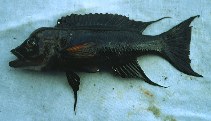
Solitary; lives in dark recesses of rocky habitat; moves on vertical sides of large rocks or on undersides of overhanging rocks with belly very close to substrate and using large pectoral fins; feeds on macro-invertebrates like crustaceans and insect larvae which are found in the slits, cracks, holes and crevices of their habitat (Ref. 7343, 46829). Always observed in shady parts of rocks; might be nocturnal; large eyes may be adaptation for enhanced night vision (Ref. 95525).
Life cycle and mating behavior
Maturity | Reproduction | Spawning | Eggs | Fecundity | Larvae
The female lays about 50 eggs on the roof of the pairs cave.
Maréchal, C. and M. Poll, 1991. Neolamprologus. p. 274-294. In J. Daget, J.-P. Gosse, G.G. Teugels and D.F.E. Thys van den Audenaerde (eds.) Check-list of the freshwater fishes of Africa (CLOFFA). ISNB, Brussels; MRAC, Tervuren; and ORSTOM, Paris. Vol. 4. (Ref. 5667)
IUCN Red List Status (Ref. 130435: Version 2025-2)
Threat to humans
Harmless
Human uses
Aquarium: commercial
Tools
Special reports
Download XML
Internet sources