Teleostei (teleosts) >
Albuliformes (Bonefishes) >
Albulidae (Bonefishes) > Albulinae
Etymology: Albula: Latin, albus = white (Ref. 45335).
More on author: Fowler.
Environment: milieu / climate zone / depth range / distribution range
Ecology
Freshwater; brackish; demersal; depth range ? - 50 m (Ref. 5217). Tropical
Western Atlantic: Greater Antilles and Panama to Brazil; questionably recorded from Florida Keys in USA. Replaced by Albula pacifica in the eastern Pacific (Ref. 84142).
Size / Weight / Age
Maturity: Lm ? range ? - ? cm
Max length : 51.0 cm TL male/unsexed; (Ref. 7251); common length : 40.0 cm TL male/unsexed; (Ref. 5217)
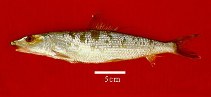
Dorsal spines (total): 0; Dorsal soft rays (total): 19 - 20; Anal spines: 0; Anal soft rays: 8. Last rays of dorsal and anal fin prolonged; upper lobe of caudal fin slightly longer than lower lobe; dusky spot at pectoral base; head region naked; nasal pore margin black; black bands on snout (Ref. 13608). Brilliant silver below and dark above (Ref. 37032).
Body shape (shape guide): fusiform / normal.
Mostly in estuaries, especially those of rivers along mountainous shores (Ref. 7251). Found on soft bottoms (Ref. 5217).
Life cycle and mating behavior
Maturity | Reproduction | Spawning | Eggs | Fecundity | Larvae
Spawning occurs in open waters. Eggs are pelagic (Ref. 205).
Robins, C.R. and G.C. Ray, 1986. A field guide to Atlantic coast fishes of North America. Houghton Mifflin Company, Boston, U.S.A. 354 p. (Ref. 7251)
IUCN Red List Status (Ref. 130435: Version 2025-2)
Threat to humans
Harmless
Human uses
Fisheries: minor commercial
Tools
Special reports
Download XML
Internet sources