>
Gobiiformes (Gobies) >
Gobiidae (Gobies) > Gobiinae
Etymology: Oplopomops: Greek, hoplon = weapon + Greek,poma, -atos = cover, operculum + Greek, ops = appearance (Ref. 45335).
More on author: Schultz.
Issue
Genus Eschmeyer, pers. comm.
Environment: milieu / climate zone / गहराई सीमा / distribution range
पारिस्थितिकी
समुद्री प्रवाल-भित्ति संयुक्त; गहराई सीमा 3 - 20 m (Ref. 90102). Tropical; 12°N - 5°S
Indian Ocean: Maldives (Ref. 30829). Pacific Ocean: Kapingamarangi (?), Marshall and Phoenix Islands.
आकार / वज़न / Age
परिपक्व अवधि: Lm ? range ? - ? cm
Max length : 7.5 cm SL पुल्लिंग / अलिंग; (Ref. 48637)
Short description
पहचान कुंजी | आकृति विज्ञान | मौरफोमैटरिक्स
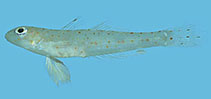
पृष्ठीय रीढ़ (सम्पूर्ण) : 7; पृष्ठीय सौफट रेज़ (सम्पूर्ण) : 10; गुदा कांटा: 1; ऐनल सौफट रेज़: 9 - 11. Characterized by translucent grey body color with brown and white spotting and row of double spots just below midlateral scale row; united pelvic fins, frenum present; rounded caudal fin, about equal to HL; longitudinal scale series 28; ctenoid scales on body and nape; predorsal scales 10; cheek and opercle without scales; depth of body 6.1 in SL (Ref. 90102).
Body shape (shape guide): fusiform / normal.
Inhabits sand patches (Ref. 37816) and fine rubble flats adjacent to reef to about 10 meters depth. Usually occurs on light coloured sand and is often partly burried (Ref. 48637). Uncertain if it associates with invertebrate burrows.
Life cycle and mating behavior
परिपक्व अवधि | पुनरुत्पत्ति | मछलीऔ का अंडे देना | अंडे | Fecundity | लार्वा
Myers, R.F., 1991. Micronesian reef fishes. Second Ed. Coral Graphics, Barrigada, Guam. 298 p. (Ref. 1602)
IUCN Red List Status (Ref. 130435: Version 2025-1)
Threat to humans
Harmless
Human uses
साधन
Special reports
Download XML
इंटरनेट स्रोत
Estimates based on models
Preferred temperature (संदर्भ
123201): 28.5 - 29.3, mean 28.9 °C (based on 448 cells).
Phylogenetic diversity index (संदर्भ
82804): PD
50 = 1.0000 [Uniqueness, from 0.5 = low to 2.0 = high].
Bayesian length-weight: a=0.01023 (0.00477 - 0.02194), b=3.01 (2.83 - 3.19), in cm total length, based on LWR estimates for this (Sub)family-body shape (Ref.
93245).
Trophic level (संदर्भ
69278): 3.3 ±0.4 se; based on size and trophs of closest relatives
लौटाव (संदर्भ
120179): ऊंचा, न्यूनतम जनसंख्या दुगनी समय अवलागत 15 महीने। (Preliminary K or Fecundity.).
Fishing Vulnerability (Ref.
59153): Low vulnerability (10 of 100).
🛈