Teleostei (teleosts) >
Ovalentaria/misc (Various families in series Ovalentaria) >
Pomacentridae (Damselfishes) > Pomacentrinae
Etymology: Pomacentrus: Greek, poma, -atos = cover, operculum + Greek, kentron = sting (Ref. 45335).
Eponymy: Annie Montague Alexander (1867–1950) was an American philanthropist and fossil collector who established the fossil collection at the University of California Museum of Paleontology, Museum of Vertebrate Zoology and sponsored collecting expeditions. [...] (Ref. 128868), visit book page.
More on authors: Evermann & Seale.
Environment: milieu / climate zone / depth range / distribution range
Ecology
Marine; reef-associated; non-migratory; depth range 5 - 60 m (Ref. 7247). Tropical
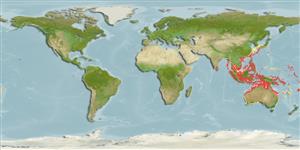
Western Pacific: Indo-Malayan Archipelago east to the Moluccas and Mentawai Islands, north to Taiwan and the Ryukyu Islands.
Size / Weight / Age
Maturity: Lm ? range ? - ? cm
Max length : 9.0 cm TL male/unsexed; (Ref. 9710)
Adults occur in lagoon, inshore, and offshore reefs (Ref. 9710). Usually seen solitary, often swimming well above substrate (Ref. 48636). Feed on algae, barnacle nauplii, copepods, fish eggs, and small gastropods. Oviparous, distinct pairing during breeding (Ref. 205). Eggs are demersal and adhere to the substrate (Ref. 205). Males guard and aerate the eggs (Ref. 205).
Life cycle and mating behavior
Maturity | Reproduction | Spawning | Eggs | Fecundity | Larvae
Oviparous, distinct pairing during breeding (Ref. 205). Eggs are demersal and adhere to the substrate (Ref. 205). Males guard and aerate the eggs (Ref. 205).
Allen, G.R., 1991. Damselfishes of the world. Mergus Publishers, Melle, Germany. 271 p. (Ref. 7247)
IUCN Red List Status (Ref. 130435: Version 2025-2)
Threat to humans
Harmless
Human uses
Tools
Special reports
Download XML
Internet sources