分类 / Names
俗名 | 同种异名 | Catalog of Fishes(属, 种) | ITIS | CoL | WoRMS | Cloffa
Teleostei >
Cichliformes (Cichlids, convict blennies)
鱸形目 (Cichlids, convict blennies) >
Cichlidae (Cichlids)
麗魚科 (Cichlids) > Pseudocrenilabrinae
Etymology: Orthochromis: Greek, ortho = straight + Greek, chromis = a fish, perhaps a perch (Ref. 45335); mporokoso: The species name mporokoso is derived from Mporokoso, a town in the Northern Province of Zambia, near the type locality of the species; a noun in apposition (Ref. 122085).
Environment: milieu / climate zone / 深度上下限 / distribution range
生态学
; 淡水 底中水层性; pH range: 6.7 - 7.3. 19°C - 20°C (Ref. 122085)
Africa: Kasinsha stream, Lake Mweru drainage, in Zambia (Ref. 122085).
大小 / 重量 / 年龄
成熟度: Lm ? range ? - ? cm
Max length : 7.5 cm SL 雄鱼/尚未辨别雌雄; (Ref. 122085)
简单描述
检索表 | 型态特徵 | 形态测量图
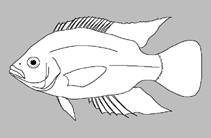
背棘 (总数) : 16 - 17; 背的软条 (总数) : 9 - 10; 臀棘: 3; 臀鳍软条: 7 - 9; 脊椎骨: 30. Diagnosis: Orthochromis mporokoso can be readily distinguished from all species currently placed in Orthochromis and O. sp. "Igamba" from the Malagarasi drainage system by having more scale rows on cheek, 2-4 vs. 0-1 (Ref. 122085). Furthermore, O. mporokoso can be distinguished from O. kasuluensis, O. mosoensis, and O. rugufuensis by having more scales on operculum, 3-4 vs. 0-2; from O. kasuluensis by having fewer total vertebrae, 30 vs. 31-32; from O. rugufuensis by fewer dorsal-fin spines, 6-17 vs. 19; from O. mazimeroensis by more horizontal line scales, 29-30 vs. 26-28, more abdominal vertebrae, 14 vs. 12-13, and more total vertebrae, 30 vs. 28-29; from O. rubrolabialis and O. uvinzae by fewer dorsal-fin spines, 16-17 vs. 18-20; it has more total gill rakers than O. rubrolabialis, 10-12 vs. 8-9, and differs in position of pterygiophore supporting last dorsal-fin spine, vertebral count 16 vs. 17-18 (Ref. 122085). It differs from O. uvinzae additionally by having fewer scales between upper lateral line and dorsal-fin origin, 4-5 vs. 6-8, fewer abdominal vertebrae, 14 vs. 15-16, fewer total vertebrae, 30 vs. 31-33, position of pterygiophore supporting last dorsal-fin spine, vertebral count 16 vs. 18-19, position of pterygiophore supporting last anal-fin spine, vertebral count 14-15 vs. 16-17; from O. luongoensis and O. torrenticola by having fewer caudal vertebrae, 16 vs. 17-18, and total vertebrae, 30 vs. 31-33; from O. kalungwishiensis by having fewer total vertebrae, 30 vs. 31-33, and fewer horizontal line scales, 29-30 vs. 31-32; from O. torrenticola additionally by having fewer anal-fin spines, 3 vs. 4, and position of pterygiophore supporting last anal-fin spine, vertebral count 14-15 vs. 16-17 (Ref. 122085). It can be distinguished from O. stormsi and O. polyacanthus by having fewer scales between upper lateral line and dorsal-fin origin, 4-5 vs. 6-9; in addition, it is distinguished from O. stormsi by having more horizontal line scales, 29-30 vs. 26-28, more total vertebrae, 30 vs. 28-29, and fewer total gill rakers, 10-12 vs. 13-15; from O. polyacanthus by having more series of scales on cheek, 2-4 vs. 0, fewer dorsal-fin spines, 16-17 vs. 18-20, and in position of pterygiophore supporting last dorsal-fin spine, vertebral count 16 vs. 17-18, as in position of pterygiophore supporting last anal-fin spine, vertebral count 14-15 vs. 16-17 (Ref. 122085). Meristic values of O. mporokoso overlap with those of O. machadoi, but it can be readily distinguished by having more vertical bars on flanks, 13-15 vs. 9-10, which moreover extend mainly ventrally; those of O. machadoi extend mainly dorsally; in addition, it is distinguished in head mask pattern, i.e. V-shape nostril stripe in O. mporokoso vs. straight nostril stripe in O. machadoi; cheek stripe present vs. absent in O. machadoi (Ref. 122085). It differs from Schwetzochromis neodon by ahving more circumpeduncular scales, 16 vs. 12, fewer inner series of teeth, 1-3 vs. 4-6, and fewer dorsal-fin rays, 9-10 vs. 11-12; it differs from Haplochromis bakongo and Haplochromis moeruensis by having more horizontal line scales, 29-30 vs. 26-28, more caudal vertebrae, 16 vs. 12-15, and more total vertebrae, 30 vs. 26-29; additionally, it is distinguished from H. moeruensis by having more upper lateral line scales, 21-23 vs. 19-20; from H. bakongo by having more dorsal-fin spines, 16-17 vs. 14-15, and in position of pterygiophore supporting last dorsal-fin spine, vertebral count 16 vs. 13-14; and from H. snoeksi it is distinguished by having more abdominal vertebrae, 14 vs. 13, fewer caudal vertebrae, 16 vs. 17, more anal-fin rays, 7-9 vs. 5-6, more total gill rakers, 10-12 vs. 9, and in position of pterygiophore supporting last dorsal-fin spine, vertebral count 16 vs. 15, and position pterygiophore supporting last anal-fin spine, vertebral count 14-15 vs. 13 (Ref. 122085). Meristic values of O. mporokoso overlap with those of Haplochromis vanheusdeni, but it lacks eggspots, has a nostril stripe vs. absent in H. vanheusdeni, exhibits a cheek stripe vs. absent in H. vanheusdeni, and has a higher number of vertical bars on flank, 13-15 vs. 6-7 (Ref. 122085). It differs from O. kimpala by having fewer scales between upper lateral line and dorsal-fin origin, 4-5 vs. 6-7; from O. indermauri by having more series of scales on the cheek, 2-4 vs. 0-1, more caudal vertebrae, 16 vs. 14-15, and more total vertebrae, 30 vs. 28-29 (Ref. 122085). Meristic values of O. mporokoso overlap with those of O. katumbii but former differs by having more vertical bars on flank, 13-15 vs. 7-9, and by head mask pattern, cheek stripe present vs. absent in O. katumbii; meristic values of O. mporokoso overlap with those of O. gecki but former is distinguished by having much wide interorbital, 1.3-19.5% of head length vs. 9.6-12.9%, and by lacking eggspots on anal fin vs. present in O. gecki (Ref. 122085).
Body shape (shape guide): fusiform / normal.
A benthic-rheophilic species (Ref. 122085).
Life cycle and mating behavior
成熟度 | 繁殖 | 产卵场 | 卵 | 孕卵数 | 仔鱼
Schedel, F.D.B., E.J.W.M.N. Vreven, B. Katemo Manda, E. Abwe, A. Chocha Manda and U.K. Schliewen, 2018. Description of five new rheophilic Orthochromis species (Teleostei: Cichlidae) from the Upper Congo drainage in Zambia and the Democratic Republic of the Congo. Zootaxa 4461(3):301-349. (Ref. 122085)
世界自然保护联盟红皮书 (Ref. 130435: Version 2025-1)
人类利用
工具
特别资料
下载 XML
网络资源
Estimates based on models
Phylogenetic diversity index (参考文献
82804): PD
50 = 0.5000 [Uniqueness, from 0.5 = low to 2.0 = high].
Bayesian length-weight: a=0.01000 (0.00244 - 0.04107), b=3.04 (2.81 - 3.27), in cm total length, based on all LWR estimates for this body shape (Ref.
93245).
回复力 (参考文献
120179): 高度, 族群倍增时间少于 15个月 (Preliminary K or Fecundity.).
Fishing Vulnerability (Ref.
59153): Low vulnerability (10 of 100).
🛈