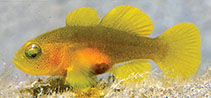
>
Gobiiformes (Gobies) >
Gobiidae (Gobies) > Gobiinae
Etymology: Lubricogobius: Latin, lubricus = slipperiness, smoothness + Latin, gobius = gudgeon (Ref. 45335); nanus: Name from Latin 'nanus' , referring to its small size, which is the most diminutive in the genus.
Environment: milieu / Zona climática / intervalo de profundidade / distribution range
Ecologia
marinhas bentopelágico; intervalo de profundidade 8 - 13 m (Ref. 107278). Tropical
Western Pacific: Papua New Guinea.
Tamanho / Peso / Idade
Maturidade: Lm ? range ? - ? cm
Max length : 1.1 cm SL macho/indeterminado; (Ref. 107278); 1.1 cm SL (female)
Descrição suscinta
Chaves de identificação | Morfologia | Morfometria
Espinhos dorsais (total) : 7; Raios dorsais (total) : 10 - 11; Espinhos anais: 1; Raios anais : 8 - 9. This species is distinguished by the following characters: D VI-I,10-11; A I,8-9; pectoral-fin rays 19; with anterior nostrils; no scales; pelvic disc with distinct frenum; mid-lateral row of widely-spaced sensory papillae on side of body and approximately 15 scattered sensory papillae on middle portion of caudal fin; body depth 3.0-3.4 in SL; head length 2.7-2.9 in SL; head compressed, width 1.1-1.4 in head depth; rounded caudal fin, shorter than head, in SL; colour in life generally brown except the yellowish head and fins with dense covering of tiny brown chromatophores, those of pectoral and pelvic fins are mainly confined to basal half of fin; iris yellow (Ref. 107278).
Body shape (shape guide): fusiform / normal; Cross section: compressed.
The type specimens were obtained within 100 m of each other on an approximately 20° mud slope. Two specimens were collected together from the inside of a dead bivalve while the other two were found on either filamentous algae or sponge that covered bottom debris, including a piece of wood and a cement block, and a fifth uncollected specimen was also observed and photographed in the same dead bivalve mentioned above (Ref. 107278).
Ciclo de vida ou comportamento de acasalamento
Maturidade | Reprodução | Desova | Ovos | Fecundidade | Larvas
Allen, G.R., 2015. Lubricogobius nanus, a new species of goby (Pisces: Gobiidae) from eastern Papua New Guinea. J. Ocean Sci. Found. 17:1-11. (Ref. 107278)
Status na Lista Vermelha da UICN (Ref. 130435: Version 2025-1)
Ameaça para os humanos
Harmless
Uso pelos humanos
Pescarias: sem interesse
Ferramentas
Relatórios especiais
Baixar XML
Fontes da internet
Estimates based on models
Índice de diversidade filogenética (Ref.
82804): PD
50 = 0.5078 [Uniqueness, from 0.5 = low to 2.0 = high].
Bayesian length-weight: a=0.01023 (0.00477 - 0.02194), b=3.01 (2.83 - 3.19), in cm total length, based on LWR estimates for this (Sub)family-body shape (Ref.
93245).
Nível Trófico (Ref.
69278): 2.9 ±0.3 se; based on size and trophs of closest relatives
Resiliência (Ref.
120179): Elevada, tempo mínimo de duplicação da população menor que 15 meses (Preliminary K or Fecundity.).
Fishing Vulnerability (Ref.
59153): Low vulnerability (10 of 100).
🛈