-

- About this page
- Languages
- User feedbacks
- Citation
- Uploads
-
Related species
- Species in
Metzia - Species in
Xenocyprididae - - Classification -
- Xenocyprididae
- Cypriniformes
- Teleostei
- Chordata
- Animalia
- Species in
-



Upload your photos and videos
Google image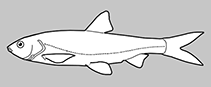 No image available for this species;
drawing shows typical species in Xenocyprididae.
Google image
drawing shows typical species in Xenocyprididae.
Classification / Names Common names | Synonyms | Catalog of Fishes(genus, species) | ITIS | CoL | WoRMS | Cloffa
Teleostei (teleosts) > Cypriniformes (Carps) > Xenocyprididae (East Asian minnows)
Etymology: bounthobi: Named for Bounthob Praxaysombath (NUOL), who was the leading researcher performing the field surveys throughout the NUOL-NEF project on 2007-2010. Eight of all 10 type series of the new species were brought from the project surveys.
Eponymy: Dr Charles William Metz (1889–1975) was an American zoologist, geneticist and taxonomist whose doctorate was awarded by Stanford University. He co-wrote: A catalog of the fishes known from the waters of Korea (1913). Dr Bounthob Praxaysombath is a zoologist, entomologist and arachnologist at the National University of Laos, Vientiane, where he is Professor and Head of the Deapartment of Biology, Faculty of Science. [...] (Ref. 128868), visit book page.
Etymology: bounthobi: Named for Bounthob Praxaysombath (NUOL), who was the leading researcher performing the field surveys throughout the NUOL-NEF project on 2007-2010. Eight of all 10 type series of the new species were brought from the project surveys.
Eponymy: Dr Charles William Metz (1889–1975) was an American zoologist, geneticist and taxonomist whose doctorate was awarded by Stanford University. He co-wrote: A catalog of the fishes known from the waters of Korea (1913). Dr Bounthob Praxaysombath is a zoologist, entomologist and arachnologist at the National University of Laos, Vientiane, where he is Professor and Head of the Deapartment of Biology, Faculty of Science. [...] (Ref. 128868), visit book page.
Environment: milieu / climate zone / depth range / distribution range Ecology
Freshwater; benthopelagic. Tropical
Distribution Territories | FAO areas | Ecosystems | Occurrences | Point map | Introductions | Faunafri
Asia: Ou River basin (a tributary of the Mekong) in Phongsaly and Luang Prabang provinces of Laos.
Size / Weight / Age
Short description Identification keys | Morphology | Morphometrics
Dorsal soft rays (total): 10; Anal soft rays: 21 - 23. Differs from all other species of Metzia in having the following characters: anal fin with 18-20 branched rays; scales on lateral line 49-55; predorsal scale rows 33-36; circumpeduncular scale rows 20-22; gill rakers on outer surface of first gill arch 8-10. Resembles species of Hemiculterella, Ischikauia and at least a part of Anabarilius in sharing a sharp keel restricted in development to the area between pelvic-fin base and anus, last unbranched dorsal-fin ray being soft, and an air bladder composed of two chambers. However, this species differs in having the following characters; a notably rounded snout (vs. pointed in Hemiculterella, Ischikauia and Anabarilius); 18-20 branched anal-fin rays (vs. 8-17 in Hemiculterella, Ischiakua and Anabarilius ); 49-55 lateral-line scales (vs. more than 58 in Ischikauia and Anabarilius, except for A. transmontana with 54-57); air bladder with rounded posterior end (vs. posterior end with a small lobe at least in Hemiculterella); and 39-40 vertebrae (vs. 40-43, 42-43 and 43-48 in Hemiculterella, Ischikauia and Anabarilius, respectively). Also similar to its sympatric species Paralaubuca barroni but can be readily distinguished by having 18-20 anal-fin rays (vs. 24-29 ) and 8-10 gill rakers (vs. 19-24) and a distinct keel between anus and a vertical through posterior end of pelvic-fin base, keel preceded by a very weak midventral, blunt ridge extending anteriorly to a vertical through posterior half of pectoral fin (vs. a distinct, complete abdominal keel extending from anus to isthmus) (Ref. 93140).
Body shape (shape guide): elongated.
Body shape (shape guide): elongated.
Occurs in upland clear streams with moderate or slow current (Ref. 93140).
Life cycle and mating behavior Maturity | Reproduction | Spawning | Eggs | Fecundity | Larvae
Main reference
Upload your references | References | Coordinator | Collaborators
Shibukawa, K., P. Phousavanh, K. Phongsa and A. Iwata, 2012. A new species of Metzia (Cypriniformes: Cyprinidae) from Northern Laos. Zootaxa 3586:264-271. (Ref. 93140)
CITES
Not Evaluated
Threat to humans
Harmless
Human uses
FAO - Publication: search | FishSource |
More information
Trophic ecology
Food items (preys)
Diet composition
Food consumption
Food rations
Predators
Food items (preys)
Diet composition
Food consumption
Food rations
Predators
Ecology
Ecology
Ecology
Population dynamics
Growth parameters
Max. ages / sizes
Length-weight rel.
Length-length rel.
Length-frequencies
Mass conversion
Recruitment
Abundance
Growth parameters
Max. ages / sizes
Length-weight rel.
Length-length rel.
Length-frequencies
Mass conversion
Recruitment
Abundance
Life cycle
Reproduction
Maturity
Maturity/Gills rel.
Fecundity
Spawning
Spawning aggregations
Eggs
Egg development
Larvae
Larval dynamics
Reproduction
Maturity
Maturity/Gills rel.
Fecundity
Spawning
Spawning aggregations
Eggs
Egg development
Larvae
Larval dynamics
Anatomy
Gill area
Brain
Otolith
Gill area
Brain
Otolith
Physiology
Body composition
Nutrients
Oxygen consumption
Swimming type
Swimming speed
Visual pigments
Fish sound
Diseases & Parasites
Toxicity (LC50s)
Body composition
Nutrients
Oxygen consumption
Swimming type
Swimming speed
Visual pigments
Fish sound
Diseases & Parasites
Toxicity (LC50s)
Genetics
Genome
Genetics
Heterozygosity
Heritability
Genetic Diversity
Genome
Genetics
Heterozygosity
Heritability
Genetic Diversity
Human related
Aquaculture systems
Aquaculture profiles
Strains
Ciguatera cases
Stamps, coins, misc.
Aquaculture systems
Aquaculture profiles
Strains
Ciguatera cases
Stamps, coins, misc.
Tools
Special reports
Download XML
Internet sources
AFORO (otoliths) | Aquatic Commons | BHL | Cloffa | Websites from users | Check FishWatcher | CISTI | Catalog of Fishes: genus, species | DiscoverLife | ECOTOX | FAO - Publication: search | Faunafri | Fishipedia | Fishtrace | GloBI | Google Books | Google Scholar | Google | IGFA World Record | OneZoom | Open Tree of Life | Otolith Atlas of Taiwan Fishes | PubMed | Reef Life Survey | Socotra Atlas | TreeBase | Tree of Life | Wikipedia: Go, Search |