Классификация / Names
народные названия | синонимы | Catalog of Fishes(род, виды) | ITIS | CoL | WoRMS | Cloffa
>
Cichliformes (Cichlids, convict blennies) >
Cichlidae (Cichlids) > Pseudocrenilabrinae
Etymology: Cynotilapia: Greek, kyon = dog + Bechuana, African native thiape = fish (Ref. 45335); aurifrons: From latin auri = gold, and frons = brow, in reference to frontal coloration in males; this name is preferred to the widely used 'Mbamba' - given as an informal name by Ribbink et al. (1983) -, because it refers to Mbamba Islet, near Likoma Island on the central eastern coast, far from that of the type material, which comes from the northwestern coast; specimens from Mbamba Islet may prove later to represent a different subspecies, then the name 'Mbamba' would remain available (Ref. 88848).
Environment: milieu / climate zone / пределы глубины / distribution range
экология
; пресноводный донно-пелагический. Tropical
Africa: Lake Malawi (Ref. 88848).
Size / Вес / Возраст
половая зрелость: Lm ? range ? - ? cm
Max length : 7.3 cm SL самец/пол неопределен; (Ref. 88848)
Краткое описание
определительные ключи | морфология | морфометрия
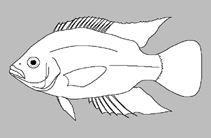
колючие лучи спинного плавника (общее число) : 15 - 17; членистые (мягкие) лучи спинного плавника (общее число) : 8 - 10; колючие лучи анального плавника: 3; членистые (мягкие) лучи анального плавника: 7 - 8. Diagnosis: This species of Microchromis is characterized by a blue-white pattern with dark vertical bars on body, enhanced in dominant specimens, where these bars almost hide the underlying colour; bars sometimes slightly extending onto dorsal fin; similar to the Maylandia zebra species group, with which they share the same overall colouration; differs from these mainly by dentition: teeth on outer rows short and conical, regularly decreasing in size from symphysis to corner, vs. bicuspid in Maylandia (Ref. 88848). It differs from Microchromis zebroides by its heavily black pattern and melanic pattern not extending onto brow, which shows a brilliant blue to yellow hue, according to the locality; dorsal fin yellow, with black submarginal band and whitish marginal band (Ref. 88848).
Body shape (shape guide): fusiform / normal.
Life cycle and mating behavior
половая зрелость | размножение | нерест | икра | Fecundity | личинки
Li, S., A.F. Konings and J.R. Stauffer Jr., 2016. A revision of the Pseudotropheus elongatus species group (Teleostei: Cichlidae) with description of a new genus and seven new species. Zootaxa 4168(2):353-381. (Ref. 119465)
Статус Красного Списка МСОП (Ref. 130435: Version 2025-1)
Угроза для людей
Harmless
Использование человеком
дополнительная информация
инструменты
Специальные отчеты
Скачать в формате XML
ресурсы в Интернет
Estimates based on models
Phylogenetic diversity index (ссылка
82804): PD
50 = 0.5312 [Uniqueness, from 0.5 = low to 2.0 = high].
Bayesian length-weight: a=0.01000 (0.00244 - 0.04107), b=3.04 (2.81 - 3.27), in cm total length, based on all LWR estimates for this body shape (Ref.
93245).
Trophic level (ссылка
69278): 3.4 ±0.4 se; based on size and trophs of closest relatives
Fishing Vulnerability (Ref.
59153): Low vulnerability (10 of 100).
🛈