-

- About this page
- Languages
- User feedbacks
- Citation
- Uploads
-
Related species
- Species in
Petrocephalus - Species in
Mormyridae - - Classification -
- Mormyridae
- Osteoglossiformes
- Teleostei
- Chordata
- Animalia
- Species in
-



Petrocephalus pulsivertens Lavoué, Sullivan & Arnegard, 2010
Upload your photos and videos
Google image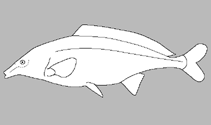 No image available for this species;
drawing shows typical species in Mormyridae.
Google image
drawing shows typical species in Mormyridae.
Classification / Names Common names | Synonyms | Catalog of Fishes(genus, species) | ITIS | CoL | WoRMS | Cloffa
Teleostei (teleosts) > Osteoglossiformes (Bony tongues) > Mormyridae (Elephantfishes)
Etymology: Petrocephalus: Latin, petra = stone + Greek, kephale = head (Ref. 45335); pulsivertens: The species name comes from the Latin 'pulsus', meaning impulse, beating; and from 'vertere', meaning to turn, exchange; the name describes the unusual EOD waveform of the species (Ref. 85331).
Etymology: Petrocephalus: Latin, petra = stone + Greek, kephale = head (Ref. 45335); pulsivertens: The species name comes from the Latin 'pulsus', meaning impulse, beating; and from 'vertere', meaning to turn, exchange; the name describes the unusual EOD waveform of the species (Ref. 85331).
Environment: milieu / climate zone / depth range / distribution range Ecology
Freshwater; benthopelagic. Tropical
Distribution Territories | FAO areas | Ecosystems | Occurrences | Point map | Introductions | Faunafri
Africa: middle Congo River basin (Ref. 85331, 113655) in Cameroon, Central African Republic and Republic of Congo.
Size / Weight / Age
Short description Identification keys | Morphology | Morphometrics
Diagnosis: Petrocephalus pulsivertens is distinguished from all other Petrocephalus species in Central Africa by the following combination of characteristics: dorsal fin with at least 25 branched rays; anal fin with at least 31 branched rays; mouth large, the ratio head length and mouth width between 2.0 and 3.7; 15-21 teeth in the upper jaw; 24-30 teeth in the lower jaw; and eye large, the ratio head length and eye-diameter between 3,2 and 3,5 (Ref. 85331). Pigmentation pattern consists of two distinctive melanin markings (black patches): (1) a distinct ovoid mark below the anterior base of the dorsal fin; and (2) a crescent-like mark, sometimes diffuse, centered at the base of the caudal fin and extending onto the upper and lower parts of the caudal fin (Ref. 85331).
Body shape (shape guide): fusiform / normal.
Body shape (shape guide): fusiform / normal.
The EOD waveform of Petrocephalus pulsivertens resembles an inverted-polarity version of the 'typical' Petrocephalus EOD (Ref. 85331).
Life cycle and mating behavior Maturity | Reproduction | Spawning | Eggs | Fecundity | Larvae
Main reference
Upload your references | References | Coordinator | Collaborators
Lavoué, S., J.P. Sullivan and M.E. Arnegard, 2010. African weakly electric fishes of the genus Petrocephalus (Osteoglossomorpha: Mormyridae) of Odzala National Park, Republic of the Congo (Lékoli River, Congo River basin) with description of five new species. Zootaxa 2600:1-52. (Ref. 85331)
CITES
Not Evaluated
Threat to humans
Harmless
Human uses
FAO - Publication: search | FishSource |
More information
Trophic ecology
Food items (preys)
Diet composition
Food consumption
Food rations
Predators
Food items (preys)
Diet composition
Food consumption
Food rations
Predators
Ecology
Ecology
Ecology
Population dynamics
Growth parameters
Max. ages / sizes
Length-weight rel.
Length-length rel.
Length-frequencies
Mass conversion
Recruitment
Abundance
Growth parameters
Max. ages / sizes
Length-weight rel.
Length-length rel.
Length-frequencies
Mass conversion
Recruitment
Abundance
Life cycle
Reproduction
Maturity
Maturity/Gills rel.
Fecundity
Spawning
Spawning aggregations
Eggs
Egg development
Larvae
Larval dynamics
Reproduction
Maturity
Maturity/Gills rel.
Fecundity
Spawning
Spawning aggregations
Eggs
Egg development
Larvae
Larval dynamics
Anatomy
Gill area
Brain
Otolith
Gill area
Brain
Otolith
Physiology
Body composition
Nutrients
Oxygen consumption
Swimming type
Swimming speed
Visual pigments
Fish sound
Diseases & Parasites
Toxicity (LC50s)
Body composition
Nutrients
Oxygen consumption
Swimming type
Swimming speed
Visual pigments
Fish sound
Diseases & Parasites
Toxicity (LC50s)
Genetics
Genome
Genetics
Heterozygosity
Heritability
Genetic Diversity
Genome
Genetics
Heterozygosity
Heritability
Genetic Diversity
Human related
Aquaculture systems
Aquaculture profiles
Strains
Ciguatera cases
Stamps, coins, misc.
Aquaculture systems
Aquaculture profiles
Strains
Ciguatera cases
Stamps, coins, misc.
Tools
E-book | Field guide | Identification keys | Length-frequency wizard | Life-history tool | Point map |
Catch-MSY |
Special reports
Download XML
Internet sources
AFORO (otoliths) | Aquatic Commons | BHL | Cloffa | Websites from users | Check FishWatcher | CISTI | Catalog of Fishes: genus, species | DiscoverLife | ECOTOX | FAO - Publication: search | Faunafri | Fishipedia | Fishtrace | GloBI | Google Books | Google Scholar | Google | IGFA World Record | OneZoom | Open Tree of Life | Otolith Atlas of Taiwan Fishes | PubMed | Reef Life Survey | Socotra Atlas | TreeBase | Tree of Life | Wikipedia: Go, Search |