-

- About this page
- Languages
- User feedbacks
- Citation
- Uploads
-
Related species
- Species in
Gymnotus - Species in
Gymnotidae - - Classification -
- Gymnotinae
- Gymnotidae
- Gymnotiformes
- Teleostei
- Chordata
- Animalia
- Species in
-



Upload your photos and videos
Google image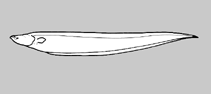 No image available for this species;
drawing shows typical species in Gymnotidae.
Google image
drawing shows typical species in Gymnotidae.
Classification / Names Common names | Synonyms | Catalog of Fishes(genus, species) | ITIS | CoL | WoRMS | Cloffa
Teleostei (teleosts) > Gymnotiformes (Knifefishes) > Gymnotidae (Naked-back knifefishes) > Gymnotinae
Etymology: Gymnotus: Greek, gymnos = naked (Ref. 45335); chaviro: From the common name for Gymnotus in the language of the Asheninka indigenous people (Arawak/Maipurean language family). A noun in apposition.
Etymology: Gymnotus: Greek, gymnos = naked (Ref. 45335); chaviro: From the common name for Gymnotus in the language of the Asheninka indigenous people (Arawak/Maipurean language family). A noun in apposition.
Environment: milieu / climate zone / depth range / distribution range Ecology
Freshwater; demersal; depth range 1 - 2 m (Ref. 83382). Tropical; 25°C - ? (Ref. 83382); 9°S - 10°S, 72°W - 73°W
Distribution Territories | FAO areas | Ecosystems | Occurrences | Point map | Introductions | Faunafri
South America: Peru (upper Yuruá basin, Department Ucayali and the Manu and Tampobata rivers of the Madre de Dios basin, Department Madre de Dios).
Size / Weight / Age
Short description Identification keys | Morphology | Morphometrics
Gymnotus chaviro is unique among members of
the G. carapo group (sensu Albert et al., 2004) in having a color pattern composed of oblique, dark, unbroken pigment bands along the length of the body, dark band-pairs with wavy, irregular margins, mainly unbranched or incompletely separated, pale inter-bands rarely reaching to the dorsal midline on the anterior half of the body and crescent-shaped in abdominal area (Ref. 83382).
Facultative air-breathing in the genus (Ref. 126274)
Life cycle and mating behavior Maturity | Reproduction | Spawning | Eggs | Fecundity | Larvae
Main reference
Upload your references | References | Coordinator : Campos-da-Paz, Ricardo | Collaborators
Maxime, E.L. and J.S. Albert, 2009. A new species of Gymnotus (Gymnotiformes: Gymnotidae) from the Fitzcarrald Arch of southeastern Peru. Neotrop. Ichthyol. 7(4):579-585. (Ref. 83382)
IUCN Red List Status (Ref. 130435: Version 2025-2)
Least Concern (LC) ; Date assessed: 24 April 2014
CITES
Not Evaluated
Threat to humans
Harmless
Human uses
FAO - Publication: search | FishSource |
More information
Trophic ecology
Food items (preys)
Diet composition
Food consumption
Food rations
Predators
Food items (preys)
Diet composition
Food consumption
Food rations
Predators
Population dynamics
Growth parameters
Max. ages / sizes
Length-weight rel.
Length-length rel.
Length-frequencies
Mass conversion
Recruitment
Abundance
Growth parameters
Max. ages / sizes
Length-weight rel.
Length-length rel.
Length-frequencies
Mass conversion
Recruitment
Abundance
Life cycle
Reproduction
Maturity
Maturity/Gills rel.
Fecundity
Spawning
Spawning aggregations
Eggs
Egg development
Larvae
Larval dynamics
Reproduction
Maturity
Maturity/Gills rel.
Fecundity
Spawning
Spawning aggregations
Eggs
Egg development
Larvae
Larval dynamics
Anatomy
Gill area
Brain
Otolith
Gill area
Brain
Otolith
Physiology
Body composition
Nutrients
Oxygen consumption
Swimming type
Swimming speed
Visual pigments
Fish sound
Diseases & Parasites
Toxicity (LC50s)
Body composition
Nutrients
Oxygen consumption
Swimming type
Swimming speed
Visual pigments
Fish sound
Diseases & Parasites
Toxicity (LC50s)
Genetics
Genome
Genetics
Heterozygosity
Heritability
Genetic Diversity
Genome
Genetics
Heterozygosity
Heritability
Genetic Diversity
Human related
Aquaculture systems
Aquaculture profiles
Strains
Ciguatera cases
Stamps, coins, misc.
Aquaculture systems
Aquaculture profiles
Strains
Ciguatera cases
Stamps, coins, misc.
Tools
Special reports
Download XML
Internet sources
AFORO (otoliths) | Aquatic Commons | BHL | Cloffa | Websites from users | Check FishWatcher | CISTI | Catalog of Fishes: genus, species | DiscoverLife | ECOTOX | FAO - Publication: search | Faunafri | Fishipedia | Fishtrace | GloBI | Google Books | Google Scholar | Google | IGFA World Record | OneZoom | Open Tree of Life | Otolith Atlas of Taiwan Fishes | PubMed | Reef Life Survey | Socotra Atlas | TreeBase | Tree of Life | Wikipedia: Go, Search |