-

- About this page
- Languages
- User feedbacks
- Citation
- Uploads
- Related species
-



Pterocerdale insolita Hoese & Motomura, 2009
Upload your photos and videos
Pictures | Google image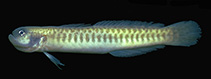 Pterocerdale insolita
Female Picture by Hoese, D.F.
Pictures | Google image
Female Picture by Hoese, D.F.
Classification / Names Common names | Synonyms | Catalog of Fishes(genus, species) | ITIS | CoL | WoRMS | Cloffa
Teleostei (teleosts) > Gobiiformes (Gobies) > Microdesmidae (Wormfishes) > Ptereleotrinae
Etymology: Pterocerdale: Name from the arbitrary combination of letters from Ptereleotrinae + Cerdale, relating to the placement in the Ptereleotrinae and similarity to the microdesmine genus Cerdale; insolita: From the Latin insolitus = strange, unusual, uncommon, all features of the new species. An adjective.
More on authors: Hoese & Motomura.
Etymology: Pterocerdale: Name from the arbitrary combination of letters from Ptereleotrinae + Cerdale, relating to the placement in the Ptereleotrinae and similarity to the microdesmine genus Cerdale; insolita: From the Latin insolitus = strange, unusual, uncommon, all features of the new species. An adjective.
More on authors: Hoese & Motomura.
Environment: milieu / climate zone / depth range / distribution range Ecology
Freshwater; demersal. Tropical
Distribution Territories | FAO areas | Ecosystems | Occurrences | Point map | Introductions | Faunafri
Oceania: Australia.
Size / Weight / Age
Maturity: Lm ? range ? - ? cm
Max length : 4.4 cm SL (female)
Max length : 4.4 cm SL (female)
Short description Identification keys | Morphology | Morphometrics
Dorsal spines (total): 7; Dorsal soft rays (total): 19; Anal spines: 1; Anal soft rays: 18; Vertebrae: 26. This species is distinguished by the following characters: lower lip with free ventral margin posteriorly only; compressed head and body; elongate body; nape, cheek, preoperculum and operculum almost completely covered with scales; body covered with cycloid scales, imbricate, in 105 vertical rows; terminal mouth slightly protractile, forming an angle of about 60° to longitudinal axis of body; maxilla reaching posteriorly to below front margin of eye; head pores are all paired laterally, 5 pores around dorsal margin of each eye; relatively short and rounded snout, with length subequal to eye diameter; anterior nostril is at the end of short tube while posterior nostril is a simple pore; no teeth on vomer, tongue and palatines; conical teeth slightly curved; 2 rows on upper jaw, small, loosely attached anteriorly while teeth in outer row slightly larger, widely spaced; lower jaw with single row of loosely attached, small teeth directed dorsally, without enlarged curved canines visible in holotype; along outer edge of dentary is a series of blunt bony dorsoventrally flattened projections with rounded tip directed more or less horizontally (widely-spaced projections appear to be bony projections of dentary, not true teeth, but probably tooth sockets), space between projections about equal to width of projections; tongue tip is broadly rounded; head papillae in transverse pattern; median nuchal crest, formed by low fold of skin from first dorsal spine onto head, low; gill opening vertical, extending ventrally from pectoral-fin base below upper margin to point just below lower pectoral base, below operculum; fleshy interorbital is subequal to diameter of eye; D1 VI, D2 I,19; A I,18; pectoral-fin rays 19; segmented caudal rays 9+8; branched caudal rays 8+7; pelvic fins are separate I,4; vertebrae 12+14 (Ref. 83368).
Body shape (shape guide): elongated; Cross section: compressed.
Body shape (shape guide): elongated; Cross section: compressed.
Life cycle and mating behavior Maturity | Reproduction | Spawning | Eggs | Fecundity | Larvae
Main reference
Upload your references | References | Coordinator : Randall, John E. | Collaborators
Hoese, D.F. and H. Motomura, 2009. Descriptions of two new genera and species of ptereleotrine fishes from Australia and Japan (Teleostei: Gobioidei) with discussion of possible relationships. Zootaxa 2312:49-59. (Ref. 83368)
IUCN Red List Status (Ref. 130435: Version 2025-2)
Data deficient (DD) ; Date assessed: 21 March 2024
CITES
Not Evaluated
Threat to humans
Harmless
Human uses
FAO - Publication: search | FishSource |
More information
Trophic ecology
Food items (preys)
Diet composition
Food consumption
Food rations
Predators
Food items (preys)
Diet composition
Food consumption
Food rations
Predators
Ecology
Ecology
Ecology
Population dynamics
Growth parameters
Max. ages / sizes
Length-weight rel.
Length-length rel.
Length-frequencies
Mass conversion
Recruitment
Abundance
Growth parameters
Max. ages / sizes
Length-weight rel.
Length-length rel.
Length-frequencies
Mass conversion
Recruitment
Abundance
Life cycle
Reproduction
Maturity
Maturity/Gills rel.
Fecundity
Spawning
Spawning aggregations
Eggs
Egg development
Larvae
Larval dynamics
Reproduction
Maturity
Maturity/Gills rel.
Fecundity
Spawning
Spawning aggregations
Eggs
Egg development
Larvae
Larval dynamics
Anatomy
Gill area
Brain
Otolith
Gill area
Brain
Otolith
Physiology
Body composition
Nutrients
Oxygen consumption
Swimming type
Swimming speed
Visual pigments
Fish sound
Diseases & Parasites
Toxicity (LC50s)
Body composition
Nutrients
Oxygen consumption
Swimming type
Swimming speed
Visual pigments
Fish sound
Diseases & Parasites
Toxicity (LC50s)
Genetics
Genome
Genetics
Heterozygosity
Heritability
Genetic Diversity
Genome
Genetics
Heterozygosity
Heritability
Genetic Diversity
Human related
Aquaculture systems
Aquaculture profiles
Strains
Ciguatera cases
Stamps, coins, misc.
Aquaculture systems
Aquaculture profiles
Strains
Ciguatera cases
Stamps, coins, misc.
Tools
Special reports
Download XML
Internet sources
AFORO (otoliths) | Aquatic Commons | BHL | Cloffa | Websites from users | Check FishWatcher | CISTI | Catalog of Fishes: genus, species | DiscoverLife | ECOTOX | FAO - Publication: search | Faunafri | Fishipedia | Fishtrace | GloBI | Google Books | Google Scholar | Google | IGFA World Record | OneZoom | Open Tree of Life | Otolith Atlas of Taiwan Fishes | PubMed | Reef Life Survey | Socotra Atlas | TreeBase | Tree of Life | Wikipedia: Go, Search |