Teleostei (teleosts) >
Perciformes/Uranoscopoidei (Sand dwellers) >
Pinguipedidae (Sandperches)
Etymology: Parapercis: Greek, para = the side of + Greek, perke = perch (Ref. 45335); pacifica: Named for its distribution in the Pacific.
Environment: milieu / climate zone / depth range / distribution range
Ecology
Marine; benthopelagic; depth range 0 - 6 m (Ref. 75058). Subtropical
Western Pacific: widespread from southern Japan to Indonesia.
Size / Weight / Age
Maturity: Lm ? range ? - ? cm
Max length : 18.6 cm SL male/unsexed; (Ref. 75058); 13.1 cm SL (female)
Short description
Identification keys | Morphology | Morphometrics
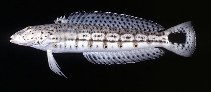
Dorsal spines (total): 5; Dorsal soft rays (total): 21 - 22; Anal spines: 1; Anal soft rays: 17 - 18. This species is distinguished by the following: pectoral fin rays usually 18; cheek region with brown semicircular or M-shaped band and many blackish spots; lower portion of the
body in males with 3-4 ocelli and several blackish and brownish spots; usually 1-2 A1-2 and A2-3 spots, 2-3 A' series spots, and B4 spot, and a series of 6-7 ocelli on the lower portion of the body with brownish spots or patches between them present in females and juveniles (Ref. 75058).
Body shape (shape guide): elongated; Cross section: oval.
Life cycle and mating behavior
Maturity | Reproduction | Spawning | Eggs | Fecundity | Larvae
Imamura, H. and T. Yoshino, 2007. Three new species of the genus Parapercis from the Western Pacific, with Rediscription of Parapercis hexophtalma (Perciformes:Pinguipedidae). Bull. Natl. Mus. Nat. Sci. Ser. A, Suppl. 1:81-100. (Ref. 75058)
IUCN Red List Status (Ref. 130435: Version 2025-2)
Threat to humans
Harmless
Human uses
Tools
Special reports
Download XML
Internet sources