-

- About this page
- Languages
- User feedbacks
- Citation
- Uploads
- Related species
-



Trygonoptera imitata Yearsley, Last & Gomon, 2008
Eastern shovelnose stingaree
Add your observation in Fish Watcher
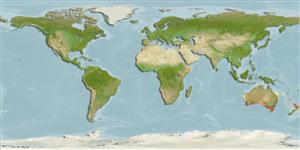
| Native range | All suitable habitat | Point map | Year 2050 |
|
| This map was computer-generated and has not yet been reviewed. |
| Trygonoptera imitata AquaMaps Data sources: GBIF OBIS |
Upload your photos and videos
Pictures | Google image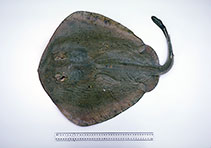 Trygonoptera imitata
Picture by Graham, K.
Pictures | Google image
Picture by Graham, K.
Classification / Names Common names | Synonyms | Catalog of Fishes(genus, species) | ITIS | CoL | WoRMS | Cloffa
Elasmobranchii (sharks and rays) > Myliobatiformes (Stingrays) > Urolophidae (Round rays)
Etymology: Trygonoptera: Greek, trygon = a sting ray + Greek, pteron = wing, fin (Ref. 45335); imitata: Name from Latin 'imitor', to copy or mimic, refers to its similarity to Trygonoptera mucosa and T. testacea in general appearance resulting in confusion over their identities.
More on authors: Yearsley, Last & Gomon.
Etymology: Trygonoptera: Greek, trygon = a sting ray + Greek, pteron = wing, fin (Ref. 45335); imitata: Name from Latin 'imitor', to copy or mimic, refers to its similarity to Trygonoptera mucosa and T. testacea in general appearance resulting in confusion over their identities.
More on authors: Yearsley, Last & Gomon.
Environment: milieu / climate zone / depth range / distribution range Ecology
Marine; benthopelagic; depth range ? - 120 m (Ref. 76956). Temperate
Distribution Territories | FAO areas | Ecosystems | Occurrences | Point map | Introductions | Faunafri
Southern Oceans: Australia.
Length at first maturity / Size / Weight / Age
Maturity: Lm 47.5, range 45 - 48.2 cm
Max length : 68.9 cm TL male/unsexed; (Ref. 76956); 79.3 cm TL (female)
Max length : 68.9 cm TL male/unsexed; (Ref. 76956); 79.3 cm TL (female)
Inhabits bays and coastal waters from close inshore near beaches to depths of at least
120 m (Ref. 76956).
Life cycle and mating behavior Maturity | Reproduction | Spawning | Eggs | Fecundity | Larvae
Main reference
Upload your references | References | Coordinator | Collaborators
Yearsley, G.K., P.R. Last and M.F. Gomon, 2008. Trygonoptera imitata sp. Nov., a new stingaree (Myliobatoidei: Urolophidae) from Southeastern Australia. pp. 261-267. In P.R. Last, W.T. White and J.J. Pogonoski (eds). Descriptions of new Australian chondrichthyans. CSIRO Marine and Atmospheric Research Paper no. 22. 365 p. (Ref. 76956)
IUCN Red List Status (Ref. 130435: Version 2025-2)
Least Concern (LC) ; Date assessed: 06 August 2018
CITES
Not Evaluated
Threat to humans
Harmless
Human uses
FAO - Publication: search | FishSource |
More information
Trophic ecology
Food items (preys)
Diet composition
Food consumption
Food rations
Predators
Food items (preys)
Diet composition
Food consumption
Food rations
Predators
Ecology
Ecology
Ecology
Population dynamics
Growth parameters
Max. ages / sizes
Length-weight rel.
Length-length rel.
Length-frequencies
Mass conversion
Recruitment
Abundance
Growth parameters
Max. ages / sizes
Length-weight rel.
Length-length rel.
Length-frequencies
Mass conversion
Recruitment
Abundance
Anatomy
Gill area
Brain
Otolith
Gill area
Brain
Otolith
Physiology
Body composition
Nutrients
Oxygen consumption
Swimming type
Swimming speed
Visual pigments
Fish sound
Diseases & Parasites
Toxicity (LC50s)
Body composition
Nutrients
Oxygen consumption
Swimming type
Swimming speed
Visual pigments
Fish sound
Diseases & Parasites
Toxicity (LC50s)
Human related
Aquaculture systems
Aquaculture profiles
Strains
Ciguatera cases
Stamps, coins, misc.
Aquaculture systems
Aquaculture profiles
Strains
Ciguatera cases
Stamps, coins, misc.
Tools
Special reports
Download XML
Internet sources
AFORO (otoliths) | Aquatic Commons | BHL | Cloffa | Websites from users | Check FishWatcher | CISTI | Catalog of Fishes: genus, species | DiscoverLife | ECOTOX | FAO - Publication: search | Faunafri | Fishipedia | Fishtrace | GloBI | Google Books | Google Scholar | Google | IGFA World Record | OneZoom | Open Tree of Life | Otolith Atlas of Taiwan Fishes | PubMed | Reef Life Survey | Socotra Atlas | TreeBase | Tree of Life | Wikipedia: Go, Search |