Classification / Names
ชื่อสามัญ | ชื่อพ้อง | Catalog of Fishes(สกุล, ชนิด) | ITIS | CoL | WoRMS | Cloffa
>
Siluriformes (Catfishes) >
Loricariidae (Armored catfishes) > Hypostominae
Etymology: Hypostomus: Greek, hypo = under + Greek, stoma = mouth (Ref. 45335); sculpodon: From the Latin sculpo (to carve, cut, grave, or chisel in stone, brass, or wood) and from the Greek odon (tooth) in reference to the ability of the species to chisel wood with the teeth.
Environment: milieu / climate zone / ระดับความลึก / distribution range
นิเวศวิทยา
; น้ำจืด สัตว์น้ำหน้าดิน. Tropical
South America: Upper Rio Negro and upper Rio Orinoco basins in Venezuela.
ขนาด / น้ำหนัก / Age
วัยเจริญพันธุ์: Lm ? range ? - ? cm
Max length : 26.4 cm SL เพศผู้/กระเทย; (Ref. 95498)
Short description
เครื่องมือที่ใช้ในการแยกชนิดสัตว์,สิ่งมีชีวิตออกจากกัน | สัณฐานวิทยา | ความยาวต่างๆ
Distinguished from all other members of the Hypostomus cochliodon group except H. hemicochliodon by having a buccal papilla and intermediately developed teeth (juveniles of H. cochliodon and H. taphorni occasionally also have intermediate teeth). Differs from H. hemicochliodon by having brownish-red coloration with widely spaced spots vs. dark brown with closely spaced spots, by having a smaller dorsal-anal length to anal-fin length ratio (average=79.2%, 69.6-89.7% vs. average=111.1%, 92.5-132.6%) and almost completely by having a smaller interorbital width/HL ratio (average=51.4%, 38.5-45.4% vs. average=49.9%, 44.1-55.6%) (Ref. 50589).
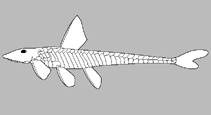
Body shape (shape guide): elongated.
Facultative air-breathing in the genus (Ref. 126274)
Life cycle and mating behavior
วัยเจริญพันธุ์ | การสืบพันธุ์ | การวางไข่ | เซลสืบพันธ์ของเพศเมีย(ไข่) | ความดกของไข่ | ตัวอ่อน
Armbruster, J.W., 2003. The species of the Hypostomus cochliodon group (Siluriformes: Loricariidae). Zootaxa 249:1-60. (Ref. 50589)
IUCN Red List Status (Ref. 130435: Version 2025-1)
Threat to humans
Harmless
Human uses
การประมง: ไม่มีผลประโยชน์
เครื่องมือ
Special reports
Download XML
แหล่งที่มาจากอินเตอร์เน็ต
Estimates based on models
Phylogenetic diversity index (อ้างอิง
82804): PD
50 = 0.5000 [Uniqueness, from 0.5 = low to 2.0 = high].
Bayesian length-weight: a=0.01622 (0.00733 - 0.03589), b=2.96 (2.79 - 3.13), in cm total length, based on LWR estimates for this Genus-body shape (Ref.
93245).
ความสามารถในการกลับคืนสู่ปกติ (อ้างอิง
120179): ขนาดกลาง, เวลาต่ำสุดที่จะทำให้ประชากรเพิ่มขึ้นเป็น 2 เท่าใช้เวลา 1.4 - 4.4 ปี (Preliminary K or Fecundity.).
Fishing Vulnerability (Ref.
59153): Low vulnerability (22 of 100).
🛈