Klassifizierung / Names
Namen | Synonyme | Catalog of Fishes(Gattung, Arten) | ITIS | CoL | WoRMS | Cloffa
>
Gobiiformes (Gobies) >
Gobiidae (Gobies) > Gobiinae
Etymology: Trimma: Greek, trimma, -atos = something crushed (Ref. 45335); cana: Specific epithet is an arbitrary combination of letters embodying the first three letters of both the English words 'candy' and 'cane'; an allusion to adding red bands to a white candy formed in the shape of a shepherd's crook. An noun in apposition.
More on author: Winterbottom.
Environment: milieu / climate zone / Tiefenbereich / distribution range
Ökologie
seewasser demersal; tiefenbereich 12 - 35 m (Ref. 90102). Tropical
Western Pacific: Philippines, Caroline Is., Fiji, Marshall Is., and Palau
Size / Gewicht / Alter
Geschlechtsreife: Lm ? range ? - ? cm
Max length : 2.5 cm SL Männchen/unbestimmt; (Ref. 52975)
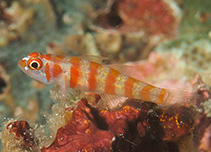
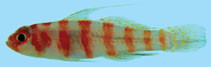
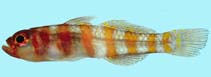
Rückenflossenstacheln (insgesamt) : 7; Rückenflossenweichstrahlen (insgesamt) : 9 - 10; Afterflossenstacheln: 1; Afterflossenweichstrahlen: 8 - 10. Diagnosis: White background with 8 distinct vertical bars on head and body; yellow spots on the medial fins; a well-defined dark bar across the postorbital region of the skull (may be partially obscured by the overlying anterior extension of the epaxialis body musculature in larger specimens). No scales on head. Opercle, cheek, or nape. A second dorsal spine varying from slightly to very elongate (as far as the mid-peduncle). A well-developed interorbital trench. A variably-developed postorbital trench (usually developed). A fifth pelvic fin ray which is unbranched and 50-85% of the fourth.
Body shape (shape guide): fusiform / normal; Cross section: compressed.
Solitary or in small groups on surface of hard corals. Inhabits steep outer reef slopes in 12-35 m (Ref. 90102).
Life cycle and mating behavior
Geschlechtsreife | Fortpflanzung | Ablaichen | Eier | Fecundity | Larven
Winterbottom, R., 2004. Three new species of Trimma (Pisces: Gobiidae) from the central, western and south Pacific. aqua, J. Ichthyol. Aquat. Biol. 9(1):7-16. (Ref. 52975)
IUCN Rote Liste Status (Ref. 130435: Version 2025-1)
Bedrohung für Menschen
Harmless
Nutzung durch Menschen
Fischereien: nicht kommerziell
Tools
Zusatzinformationen
Download XML
Internet Quellen
Estimates based on models
Preferred temperature (Ref.
123201): 26.3 - 29, mean 28 °C (based on 102 cells).
Phylogenetic diversity index (Ref.
82804): PD
50 = 0.5000 [Uniqueness, from 0.5 = low to 2.0 = high].
Bayesian length-weight: a=0.01023 (0.00477 - 0.02194), b=3.01 (2.83 - 3.19), in cm total length, based on LWR estimates for this (Sub)family-body shape (Ref.
93245).
Widerstandsfähigkeit (Ref.
120179): hoch, Verdopplung der Population dauert weniger als 15 Monate. (Preliminary K or Fecundity.).
Fishing Vulnerability (Ref.
59153): Low vulnerability (10 of 100).
🛈
Nutrients (Ref.
124155): Calcium = 1050 [421, 3,702] mg/100g; Iron = 3.08 [1.49, 7.03] mg/100g; Protein = 17.4 [15.3, 19.1] %; Omega3 = 0.285 [0.093, 0.794] g/100g; Selenium = 47.7 [15.7, 125.5] μg/100g; VitaminA = 32.2 [7.5, 129.8] μg/100g; Zinc = 4.04 [2.34, 6.73] mg/100g (wet weight);