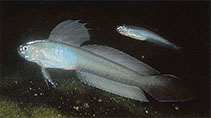
Environment: milieu / climate zone / djupintervall / distribution range
Ekologi
marina revassocierade; djupintervall 15 - 40 m (Ref. 90102). Tropical
Utbredning
Länder | FAO områden | Ekosystem | Förekomster | Prickkarta | Utplanteringar | Faunafri
Western Central Pacific.
Size / Vikt / Age
Könsmognad: Lm ? range ? - ? cm
Max length : 18.0 cm SL hane/ej könsbestämd; (Ref. 48637)
Short description
Bestämningsnycklar | Morfologi | Morfometri
Taggstrålar i ryggfenan (totalt) : 6 - 7; Mjukstrålar i ryggfenan (totalt) : 31; Taggstrålar i analfenan: 1; Mjukstrålar i analfenan: 31.
Body shape (shape guide): elongated.
Inhabits deep muddy slopes, subject to strong currents. Usually seen in small groups, often of mixed sizes (Ref. 48637).
Life cycle and mating behavior
Könsmognad | Reproduktion | Lek | Ägg | Fecundity | Larver
Larson, H.K., 2001. Microdesmidae. Wormfishes, dart-gobies, fire gobies. p. 3607-3608. In K.E. Carpenter and V. Niem (eds.) FAO species identification guide for fishery purposes. The living marine resources of the Western Central Pacific. Vol. 6. Bony fishes part 4 (Labridae to Latimeriidae), estuarine crocodiles, sea turtles, sea snakes and marine mammals. FAO, Rome. (Ref. 48398)
IUCN Red List Status (Ref. 130435: Version 2025-1)
Threat to humans
Harmless
Human uses
Verktyg
Special reports
Download XML
Internet-källor
Estimates based on models
Preferred temperature (Ref.
123201): 25.4 - 28.8, mean 27.4 °C (based on 80 cells).
Phylogenetic diversity index (Ref.
82804): PD
50 = 0.5312 [Uniqueness, from 0.5 = low to 2.0 = high].
Bayesian length-weight: a=0.00389 (0.00180 - 0.00842), b=3.12 (2.94 - 3.30), in cm total length, based on all LWR estimates for this body shape (Ref.
93245).
Trofisk nivå (Ref.
69278): 3.5 ±0.5 se; based on size and trophs of closest relatives
Fishing Vulnerability (Ref.
59153): Low vulnerability (12 of 100).
🛈