This website uses cookies to enhance your browsing experience and ensure the functionality of our site. For more detailed information about the types of cookies we use and how we protect your privacy, please visit our Privacy Information page.
×
Cookie Settings
This website uses different types of cookies to enhance your experience. Please select your preferences below:
Teleostei (teleosts) > Callionymiformes (Dragonets) > Callionymidae (Dragonets)
Etymology: Dactylopus:Greek, daktylos = finger + Greek, pous = foot (Ref. 45335); kuiteri:Named in honor of the collector, Rudie H. Kuiter of Seaford, Victoria, Australia (Ref. 35443). Eponymy: Rudolf ‘Rudie’ Herman Kuiter (d: 1943) is an Australian underwater photographer and aquarist. [...] (Ref. 128868), visit book page. More on author: Fricke.
Environment: milieu / climate zone / depth range / distribution range Ecology
Marine; demersal; depth range 3 - 15 m (Ref. 48636). Tropical
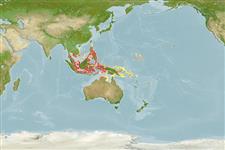
Western Central Pacific: Indonesia, Malaysia and Philippines.
Size / Weight / Age
Maturity: Lm? range ? - ? cm Max length : 15.0 cm TL male/unsexed; (Ref. 48636)
Short description Identification keys | Morphology | Morphometrics
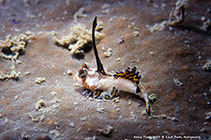
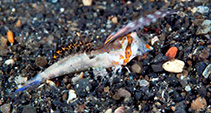
Dorsalspines (total): 4; Dorsalsoft rays (total): 9; Analspines: 0; Analsoft rays: 8. 3 dorsal points on the preopercular spine, the male's first spine of the first dorsal fin longer than the second spine, no filaments in the first dorsal fin, black and orange first and second dorsal fins, and a white head and body with black-edged orange streaks on the head and anterior back (Ref. 35443). Body shape (shape guide): fusiform / normal.
Collected from a sandy bottom (Ref. 35443). May occur solitary or in pairs (Ref. 90102).
Life cycle and mating behavior Maturity | Reproduction | Spawning | Eggs | Fecundity | Larvae
Preferred temperature (Ref. 123201): 28.3 - 29.2, mean 28.8 °C (based on 471 cells).
Phylogenetic diversity index (Ref. 82804): PD50 = 0.7500 [Uniqueness, from 0.5 = low to 2.0 = high].
Bayesian length-weight: a=0.00933 (0.00385 - 0.02260), b=2.96 (2.75 - 3.17), in cm total length, based on LWR estimates for this (Sub)family-body shape (Ref. 93245).
Trophic level (Ref. 69278): 3.3 ±0.5 se; based on size and trophs of closest relatives
Resilience (Ref. 120179): High, minimum population doubling time less than 15 months (Preliminary K or Fecundity.).
Fishing Vulnerability (Ref. 59153): Low vulnerability (10 of 100). 🛈