Classification / Names
Common names | Synonyms | Catalog of Fishes(genus, species) | ITIS | CoL | WoRMS | Cloffa
Teleostei (teleosts) >
Blenniiformes (Blennies) >
Labrisomidae (Labrisomids)
Etymology: Paraclinus: Greek, para = the side of + Greek, klinein, kline = sloping and bed, due to the four apophyses of sphenoid bone (Ref. 45335); spectator: From its habit of observing divers and its surroundings.
Environment: milieu / climate zone / depth range / distribution range
Ecology
Marine; reef-associated; depth range 1 - 7 m (Ref. 43114). Tropical
Southwest Atlantic: Brazil.
Size / Weight / Age
Maturity: Lm ? range ? - ? cm
Max length : 5.2 cm SL male/unsexed; (Ref. 43114)
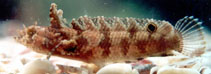
Dorsal spines (total): 27 - 29; Anal spines: 2; Anal soft rays: 18 - 20; Vertebrae: 34. Body elongated, mean body depth 21.7% SL in adult males. Wide predorsal area, mean 22.6% SL in adult males. First 2 dorsal fin spines much longer than the rest; distance between 3rd and 4th spine greater than orbit diameter; last dorsal fin element segmented. Opercular spine flattened and triangular (Ref. 43114).
Body shape (shape guide): fusiform / normal.
Prefers shallow rocky reefs. Smallest ripe female at 3.7 cm SL (Ref. 43114).
Life cycle and mating behavior
Maturity | Reproduction | Spawning | Eggs | Fecundity | Larvae
Guimarães, R.Z.P. and A.C.L.H. de Bacellar, 2002. Review of the Brazilian species of Paraclinus (Teleostei: Labrisomidae), with descriptions of two new species and revalidation of Paraclinus rubicundus (Starks). Copeia 2002(2):419-427. (Ref. 43114)
IUCN Red List Status (Ref. 130435: Version 2025-2)
Threat to humans
Harmless
Human uses
Tools
Special reports
Download XML
Internet sources