>
Syngnathiformes (Pipefishes and seahorses) >
Syngnathidae (Pipefishes and seahorses) > Syngnathinae
Etymology: Hippocampus: Greek, ippos = horse + Greek,kampe = curvature (Ref. 45335); montebelloensis: Named in reference to the Monte Bello Islands, its type locality.
Issue
Kuiter described the species (2001) and endorsed it subsequently (2009) separating it from Hippocampus zebra Whitley, 1964, while Lourie (in two publications in 2016) synonymized it with the latter species. We chose to assign an uncertain status because probably it is a case of sibling species (Kuiter) while we recognized a lack of clear evidence (Lourie) to separate them. Genetic studies have to be performed to take a documented decision.
Environment: milieu / climate zone / distribuzione batimetrica / distribution range
Ecologia
marino pelagic-neritic; non migratori. Tropical
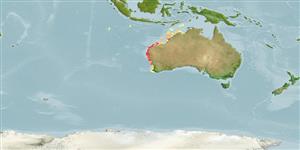
Eastern Indian Ocean: known only from Monte Bello Islands and Exmouth Gulf, Western Australia.
Size / Peso / Age
Maturità: Lm ? range ? - ? cm
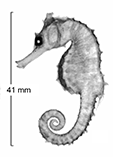
Max length : 7.8 cm OT (female)
Short description
Chiavi di identificazione | Morfologia | Morfometria
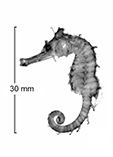
Spine dorsali (totale) : 0; Raggi dorsali molli (totale) : 18 - 19. Trunk rings 11; tail rings 37; subdorsal spines 3/0,1,0; spine above eye of moderate size, length about pupil-diameter, slightly angled back; moderately large and recurving lateral head spine; long, forward-directed nape spine; nose profile straight; coronet moderately high, with spines on corners, posterior 3 largest and directed backward; 3 spines of moderate size on shoulder ring, uppermost and central spines at end of pectoral-fin base, lowermost ventrally; superior trunk ridge with spines of small to moderate size on rings 1, 4, 7 and 11, extended by long dermal flaps at spine tips in holotype; superior tail ridge similar to superior trunk ridge, with enlarged spines at regular intervals, becoming progressively smaller posteriorly (Ref. 42735).
Body shape (shape guide): other.
Found on the continental shelf (Ref. 75154). Holotype caught at the surface, clinging to Sargassum fragment (Ref. 42735). Maximum length is based on a straight-line length measurement from upper surface (ignoring spines) of first trunk ring, to tip of tail (Ref. 42735). Ovoviviparous (Ref. 205). The male carries the eggs in a brood pouch which is found under the tail (Ref. 205).
Life cycle and mating behavior
Maturità | Riproduzione | Deposizione | Uova | Fecundity | Larve
Male carries the eggs in a brood pouch (Ref. 205).
Kuiter, R.H., 2001. Revision of the Australian seahorses of the genus Hippocampus (Syngnathiformes: Syngnathidae) with descriptions of nine new species. Rec. Aus. Mus. 53:293-340. (Ref. 42735)
IUCN Red List Status (Ref. 130435: Version 2025-1)
Threat to humans
Harmless
Human uses
Strumenti
Special reports
Download XML
Fonti Internet
Estimates based on models
Preferred temperature (Fonte Biblio.
123201): 18 - 27, mean 21.8 °C (based on 111 cells).
Phylogenetic diversity index (Fonte Biblio.
82804): PD
50 = 0.5000 [Uniqueness, from 0.5 = low to 2.0 = high].
Bayesian length-weight: a=0.00447 (0.00175 - 0.01142), b=2.99 (2.77 - 3.21), in cm total length, based on LWR estimates for this (Sub)family-body shape (Ref.
93245).
Trophic level (Fonte Biblio.
69278): 3.4 ±0.5 se; based on size and trophs of closest relatives
Resilienza (Fonte Biblio.
120179): Alto, tempo minimo di raddoppiamento della popolazione meno di 15 mesi (Preliminary K or Fecundity.).
Fishing Vulnerability (Ref.
59153): Low vulnerability (10 of 100).
🛈