Teleostei (teleosts) >
Blenniiformes (Blennies) >
Clinidae (Clinids)
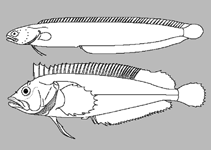
Etymology: Ophiclinops: Greek, ophis = serpent + Greek, klinein, kline = sloping and bed, due to the four apophyses of sphenoid bone + Greek, ops = appearance (Ref. 45335).
Eponymy: Dr J Barry Hutchins (d: 1946) was Curator of Fishes at the Western Australian Museum (1998–2007), which he joined as a Technical Officer (1972) and where he worked until he retired. [...] (Ref. 128868), visit book page.
Environment: milieu / climate zone / depth range / distribution range
Ecology
Marine; reef-associated; depth range 13 - 15 m (Ref. 33839). Temperate
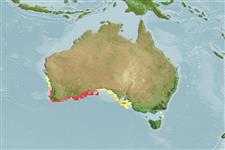
Eastern Indian Ocean: southern Australia.
Size / Weight / Age
Maturity: Lm ? range ? - ? cm
Max length : 9.5 cm TL male/unsexed; (Ref. 33839)
Short description
Identification keys | Morphology | Morphometrics
Found in areas with seagrass, reef and weed (Ref. 33839). Minimum depth from Ref. 58018.
Life cycle and mating behavior
Maturity | Reproduction | Spawning | Eggs | Fecundity | Larvae
Gomon, M.F., C.J.M. Glover and R.H. Kuiter (eds.), 1994. The fishes of Australia's south coast. State Print, Adelaide. 992 p. (Ref. 33839)
IUCN Red List Status (Ref. 130435: Version 2025-2)
Threat to humans
Harmless
Human uses
Tools
Special reports
Download XML
Internet sources