Classificatie / Namen
Lokale namen | Synoniemen | Catalog of Fishes(Genus, Soort(en)) | ITIS | CoL | WoRMS | Cloffa
>
Gobiiformes (Gobies) >
Gobiidae (Gobies) > Gobiinae
Etymology: Evermannichthys: From Evermann, 1902, researcher about fauna + greek, ichthys = fish (Ref. 45335).
Eponymy: Dr Barton Warren Evermann (1853–1932) was a schoolteacher (1876–1886) and a student at Indiana University, where he was awarded his bachelor’s degree (1886), master’s (1888) and doctorate (1891). [...] (Ref. 128868), visit book page.
Environment: milieu / Klimaatzone / Diepte / distribution range
Ecologie
marien demersaal; diepte 27 - 30 m (Ref. 40966). Tropical
Western Central Atlantic: known from the type locality, Navassa Island. Also from the Bahamas (Ref. 92840).
Grootte / Gewicht / Leeftijd
Maturiteit: Lm ? range ? - ? cm
Max length : 3.0 cm SL mannelijk / geslacht onbekend; (Ref. 92840)
Korte beschrijving
Determinatiesleutels | Morfologie | Morfometrie
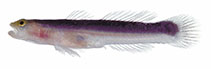
Dorsale stekels (totaal) : 6 - 7; Dorsale zachte stralen (totaal) : 10; Anale zachte stralen: 9. Distinguished by having the following characteristics: thin and elongate in form; reduced scale cover and head pores; depth of body about 2 mm (Ref. 92840); uniformly dark on dorsal third of body and pale on remainder; clear median and paired fins; frenum connecting the upper lip to snout is reduced; separated upper lip and snout; tongue is emarginate (Ref. 44822).
Obligate sponge dwellers. Live deep within canals of the sponges, near the openings to the incurrent canals. Sponges provide species with protection from predators and an available food source in many invertebrates. Eggs found within sponge or small plankton brought through incurrent pores (Ref. 92840).
Levenscyclus en paargedrag
Maturiteit | Voortplanting | Paaien | Eieren | Fecunditeit | Larven
Eschmeyer, W.N. (ed.), 2001. Catalog of fishes. Updated database version of December 2001. Catalog databases as made available to FishBase in December 2001. (Ref. 40966)
Status op de Rode Lijst van het IUCN (Ref. 130435: Version 2025-1)
Gevaar voor de mens
Harmless
Gebruik door de mens
Tools
Speciale rapporten
Download XML
Internetbronnen
Estimates based on models
Preferred temperature (Ref.
123201): 21.2 - 27.7, mean 26.5 °C (based on 42 cells).
Fylogenetische diversiteitsindex (Ref.
82804): PD
50 = 0.5312 [Uniqueness, from 0.5 = low to 2.0 = high].
Bayesian length-weight: a=0.00724 (0.00339 - 0.01546), b=3.10 (2.92 - 3.28), in cm total length, based on LWR estimates for this (Sub)family-body shape (Ref.
93245).
Trofisch niveau (Ref.
69278): 3.1 ±0.3 se; based on size and trophs of closest relatives
Weerstandsvermogen (Ref.
120179): Hoog, minimale populatieverdubbelingstijd minder dan 15 maanden (Preliminary K or Fecundity.).
Fishing Vulnerability (Ref.
59153): Low vulnerability (10 of 100).
🛈