Teleostei (teleosts) >
Gobiiformes (Gobies) >
Gobiidae (Gobies) > Gobionellinae
Etymology: Pandaka: Sanskrit, pandaka = without testicles, hermaphrodite, homosexual; it is a Philippines fish, the smallest of the world.
More on author: Herre.
Environment: milieu / climate zone / depth range / distribution range
Ecology
Marine; brackish; demersal; depth range 0 - 2 m (Ref. 90102). Tropical
Western Central Pacific.
Size / Weight / Age
Maturity: Lm ? range ? - ? cm
Max length : 1.7 cm SL male/unsexed; (Ref. 439); 1.6 cm SL (female)
Short description
Identification keys | Morphology | Morphometrics
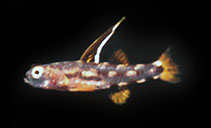
Dorsal spines (total): 6 - 7; Dorsal soft rays (total): 6 - 7; Anal spines: 1; Anal soft rays: 6 - 7. Characterized by black and white color pattern; middle of caudal fin base with black spot; translucent yellow fins except male first dorsal dark brown with yellow basal streaks and broad, white posterior margin; elongate first dorsal spine; longitudinal scale series 22-24; head and nape without scales; rounded caudal fin (Ref. 90102).
Body shape (shape guide): elongated; Cross section: oval.
Inhabits mangrove shores, occasionally near coral reefs in 0-2 m. Usually in groups, often hovering in midwater (Ref. 90102).
Life cycle and mating behavior
Maturity | Reproduction | Spawning | Eggs | Fecundity | Larvae
Larson, H.K., 2001. A revision of the gobiid fish genus Mugilogobius (Teleostei: Gobioidei), and its systematic placement. Rec. West. Aust. Mus. (Suppl. No. 62):1-233. (Ref. 43716)
IUCN Red List Status (Ref. 130435: Version 2025-2)
Threat to humans
Harmless
Human uses
Tools
Special reports
Download XML
Internet sources