Teleostei (teleosts) >
Ophidiiformes (Cusk eels) >
Ophidiidae (Cusk-eels) > Ophidiinae
Etymology: Lepophidium: Latin, lepus, leporis = rabbit + Greek, ophis = serpent (Ref. 45335).
More on authors: Goode & Bean.
Environment: milieu / climate zone / depth range / distribution range
Ecology
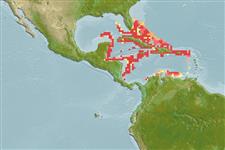
Marine; bathydemersal; depth range 155 - 525 m (Ref. 34024), usually 300 - ? m (Ref. 91765). Deep-water; 29°N - 10°N, 90°W - 63°W (Ref. 91765)
Western Central Atlantic: entire western edge of the Bahamas to Cuba, along the Antilles chain to the Virgin Islands; in the western Caribbean Sea (from Yucatan to Nicaragua).
Size / Weight / Age
Maturity: Lm ? range ? - ? cm
Max length : 22.2 cm SL male/unsexed; (Ref. 91765)
Short description
Identification keys | Morphology | Morphometrics
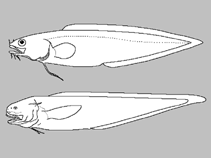
Dorsal soft rays (total): 120 - 130; Anal soft rays: 103 - 110; Vertebrae: 69 - 72. Rostral spine long and curved, reaching tip of snout, without vertical basal component; peritoneum pale; no median basibranchial tooth patch; head extensively covered with imbricate rows of cycloid scales except for snout and throat; body tapering to point, dagger-shaped (Ref. 34024).
Body shape (shape guide): eel-like; Cross section: compressed.
Uncommon species (Ref. 34024). Oviparous, with oval pelagic eggs floating in a gelatinous mass (Ref. 205).
Life cycle and mating behavior
Maturity | Reproduction | Spawning | Eggs | Fecundity | Larvae
Robins, C.R., R.H. Robins and M.E. Brown, 2012. A revision of Lepophidium (Teleoastei, Ophidiidae), with descriptions of eight new species. Bulletin of the Florida Museum of Natural History 52(1):1-94. (Ref. 91765)
IUCN Red List Status (Ref. 130435: Version 2025-2)
Threat to humans
Harmless
Human uses
Tools
Special reports
Download XML
Internet sources