Teleostei (teleosts) >
Ophidiiformes (Cusk eels) >
Ophidiidae (Cusk-eels) > Ophidiinae
Etymology: Ophidion: Diminutive of Greek, ophis = serpent (Ref. 45335).
Eponymy: Dr Charles Richard ‘Dick’ Robins (1928–2020) was an American systematic ichthyologist whom one etymology honoured as an ‘eelologist’; as well as a colleague, advisor and friend, for his contributions to the knowledge of fishes (including [...] (Ref. 128868), visit book page.
Environment: milieu / climate zone / depth range / distribution range
Ecology
Marine; demersal; depth range 12 - 45 m (Ref. 34024). Subtropical
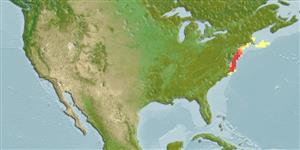
Northwest Atlantic: New Jersey to North Carolina, USA.
Size / Weight / Age
Maturity: Lm ? range ? - ? cm
Rare species (Ref. 34024). Reproductive strategy possibly similar to other members of this family featuring oviparity, with oval pelagic eggs floating in a gelatinous mass (Ref. 205).
Life cycle and mating behavior
Maturity | Reproduction | Spawning | Eggs | Fecundity | Larvae
Nielsen, J.G., D.M. Cohen, D.F. Markle and C.R. Robins, 1999. Ophidiiform fishes of the world (Order Ophidiiformes). An annotated and illustrated catalogue of pearlfishes, cusk-eels, brotulas and other ophidiiform fishes known to date. FAO Fish. Synop. 125(18):178p. Rome: FAO. (Ref. 34024)
IUCN Red List Status (Ref. 130435: Version 2025-2)
Threat to humans
Harmless
Human uses
Fisheries: of no interest
Tools
Special reports
Download XML
Internet sources