>
Eupercaria/misc (Various families in series Eupercaria) >
Labridae (Wrasses) > Cheilininae
Etymology: Novaculichthys: Latin, novacula = razor + Greek, ichthys = fish (Ref. 45335).
More on author: Lacepède.
Environment: milieu / climate zone / تغييرات عمق / distribution range
بوم شناسي
دريايي وابسته به آب سنگ; تغييرات عمق 3 - 25 m (Ref. 30573), usually ? - 14 m (Ref. 27115). Tropical; 24°C - 28°C (Ref. 27115); 30°N - 30°S, 32°E - 77°W
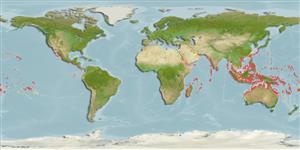
Indo-Pacific: Red Sea to South Africa (Ref. 35918) and the Tuamoto Islands, north to Ryukyu and Hawaiian islands, south to Lord Howe Island. Excluding Persian Gulf (Ref. 86689). Eastern Pacific: Gulf of California to Panama and the Galapagos Islands (Ref. 5227).
Size / Weight / سن
بلوغ: Lm ? range ? - ? cm
Max length : 30.0 cm TL جنس نر / بدون خواص جنسي; (Ref. 2334)
خارهاي باله پشتي (کل) : 9; شعاع نرم باله پشتي (کل) : 12 - 13; خارهاي باله مخرجي: 3; شعاع نرم باله مخرجي: 12 - 13. Juveniles have long extended dorsal fin spines (Ref. 48636).
Body shape (shape guide): fusiform / normal; Cross section: compressed.
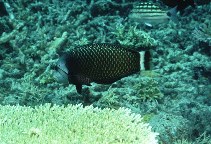
Inhabit semi-exposed reef flats and lagoon and seaward reefs (Ref. 1602). Common in areas of mixed sand, and rubble that are subject to mild surge (Ref. 1602, 58466). Benthopelagic (Ref. 58302). Juveniles shallow on rubble amongst large bommies or protected open patches on reef crests and swim as if were a leaf floating along the bottom; large adults move along over large reef section, usually in pairs and typically turn or shift large pieces of rubble or debris that they grab and pull with their mouth or push over with their snout. Often, while one works the piece, the other grabs exposed prey. They are sometimes called rock-mover wrasse, but they don't move real rocks (Ref. 48636). Highly territorial (Ref. 9823). Feed on mollusks, sea urchins, brittle stars, polychaetes, and crabs (Ref. 5213); feeding is done by overturning large rocks to expose target preys. The young imitate drifting masses of algae (Ref. 2334). Marketed fresh (Ref. 9311). Minimum depth reported from Ref. 30874.
Life cycle and mating behavior
بلوغ | تولید مثل | تخم ریزی | تخم ها | Fecundity | توزاد ( لارو)
Oviparous, distinct pairing during breeding (Ref. 205).
Randall, J.E., G.R. Allen and R.C. Steene, 1990. Fishes of the Great Barrier Reef and Coral Sea. University of Hawaii Press, Honolulu, Hawaii. 506 p. (Ref. 2334)
وضعيت در فهرست قرمز IUCN (Ref. 130435: Version 2025-1)
خطر برای انسان ها
Harmless
استفاده انسانی
ماهي گيري – شيلات: ارزش تحاري اندك; آكواريوم: تجاري
ابزارها
گزارش های ويژه
بارگيری XML
منابع اينترنتي
Estimates based on models
Preferred temperature (مرجع
123201): 24.9 - 29.3, mean 28.3 °C (based on 3357 cells).
Phylogenetic diversity index (مرجع
82804): PD
50 = 1.0000 [Uniqueness, from 0.5 = low to 2.0 = high].
Bayesian length-weight: a=0.01995 (0.01066 - 0.03736), b=2.96 (2.79 - 3.13), in cm total length, based on LWR estimates for this species & (Sub)family-body (Ref.
93245).
Trophic level (مرجع
69278): 3.3 ±0.40 se; based on food items.
جهندگی (مرجع
120179): متوسط, كمينه زمان لازم براي دو برابر شدن جمعيت 4/1 – 4/4 سال (Preliminary K or Fecundity.).
Fishing Vulnerability (Ref.
59153): Low vulnerability (20 of 100).
🛈
Nutrients (Ref.
124155): Calcium = 55.7 [34.0, 89.0] mg/100g; Iron = 0.601 [0.357, 1.082] mg/100g; Protein = 18.5 [15.7, 20.7] %; Omega3 = 0.133 [0.089, 0.197] g/100g; Selenium = 25.8 [16.4, 44.3] μg/100g; VitaminA = 112 [36, 384] μg/100g; Zinc = 1.48 [1.07, 2.34] mg/100g (wet weight);