Teleostei (teleosts) >
Gobiesociformes (Clingfishes) >
Gobiesocidae (Clingfishes and singleslits) > Gobiesocinae
Etymology: Tomicodon: Greek, tomikos, -e, -on = that is useful for cutting (Ref. 45335).
Environment: milieu / climate zone / depth range / distribution range
Ecology
Marine; demersal. Subtropical
Eastern Pacific: Lobos de Afuera, Peru to Valparaiso, Chile, including the Galapagos Islands.
Size / Weight / Age
Maturity: Lm ? range ? - ? cm
Max length : 5.0 cm TL male/unsexed; (Ref. 28023)
Short description
Identification keys | Morphology | Morphometrics
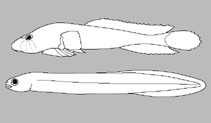
Dorsal spines (total): 0; Dorsal soft rays (total): 7 - 9; Anal spines: 0; Anal soft rays: 6 - 9. Pale with numerous small, dark-gray and black spots and vermiculations on sides; no markings on venter; prominent black spot just above pectoral fin base; fins dusky, the margins transparent. Equal numbers of teeth in each jaw, the canines strong and longer than the four pairs of incisors; middle pair of incisors smooth-edged, the outer ones trifid; posterior nostril in front of anterior margin of orbit; gill membrane attached opposite upper edge of pectoral fin; anus closer to anal-fin origin than to rear margin of disc.
Body shape (shape guide): elongated.
Facultative air-breathing in the genus (Ref. 126274); Occurs along shallow coastal shores, where it probably clings to rocks of the substratum.
Life cycle and mating behavior
Maturity | Reproduction | Spawning | Eggs | Fecundity | Larvae
Grove, J.S. and R.J. Lavenberg, 1997. The fishes of the Galápagos Islands. Stanford University Press, Stanford, 863 p. (Ref. 28023)
IUCN Red List Status (Ref. 130435: Version 2025-2)
Threat to humans
Harmless
Human uses
Tools
Special reports
Download XML
Internet sources