Teleostei (teleosts) >
Ophidiiformes (Cusk eels) >
Ophidiidae (Cusk-eels) > Neobythitinae
Etymology: Alcockia: From Albert Alcock, 1891, edited the research campaigne carried out by the ship Investigator in Bengal and Calcute (Ref. 45335).
Eponymy: Lieutenant-Colonel Dr Alfred William Alcock (1859–1933) was a British physician, herpetologist, carcinologist and naturalist. [...] (Ref. 128868), visit book page.
More on author: Günther.
Environment: milieu / climate zone / depth range / distribution range
Ecology
Marine; bathypelagic; depth range 2761 - 4040 m (Ref. 34024). Deep-water
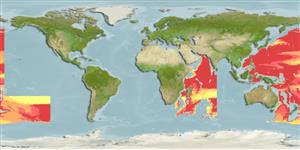
Indo-Pacific: East Africa to Japan and New Caledonia.
Size / Weight / Age
Maturity: Lm ? range ? - ? cm
Max length : 35.0 cm SL male/unsexed; (Ref. 34024)
Short description
Identification keys | Morphology | Morphometrics
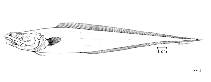
Elongated body with depressed head bearing sharp spines; eye diameter much shorter than snout; suborbital bones membranous; maxillary sheathed posterodorsally; opercular spine flat and weak; 7 developed rakers on anterior gill arch.
Rare species (Ref. 34024). Minimum depth reported by Ref. 30370. Oviparous, with oval pelagic eggs floating in a gelatinous mass (Ref. 205).
Life cycle and mating behavior
Maturity | Reproduction | Spawning | Eggs | Fecundity | Larvae
Nielsen, J.G., D.M. Cohen, D.F. Markle and C.R. Robins, 1999. Ophidiiform fishes of the world (Order Ophidiiformes). An annotated and illustrated catalogue of pearlfishes, cusk-eels, brotulas and other ophidiiform fishes known to date. FAO Fish. Synop. 125(18):178p. Rome: FAO. (Ref. 34024)
IUCN Red List Status (Ref. 130435: Version 2025-2)
Threat to humans
Harmless
Human uses
Fisheries: of no interest
Tools
Special reports
Download XML
Internet sources