Issue
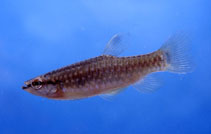
zzzAT MORPHOLOGY STOCKS P. brevis is one member of a group of Pyrrhulina species that share certain characters such as a deeper body, a longer maxillary bone with many teeth, and caudal fin lobes of almost equal length. This group includes P. lugubris in Colombia and Venezuela, P. brevis, P. obermülleri, P. spilota and a couple of new species in the upper Amazon in Peru. Marilyn Weitzman, pers. comm., Eschmeyer, 1998:282, Ortega & Vari, 1986:11.
Environment: milieu / climate zone / profondeur / distribution range
Écologie
; eau douce benthopélagique; pH range: 5.2 - 6.8; dH range: ? - 8. Tropical; 24°C - 28°C (Ref. 2060)
South America: Amazon River basin.
Taille / Poids / Âge
Maturité: Lm ? range ? - ? cm
Max length : 7.0 cm SL mâle / non sexé; (Ref. 37104)
Life cycle and mating behavior
Maturité | Reproduction | Frai | Œufs | Fécondité | Larves
Weitzman, M. and S.H. Weitzman, 2003. Lebiasinidae (Pencil fishes). p. 241-251. In R.E. Reis, S.O. Kullander and C.J. Ferraris, Jr. (eds.) Checklist of the Freshwater Fishes of South and Central America. Porto Alegre: EDIPUCRS, Brasil. (Ref. 37104)
Statut dans la liste rouge de l'IUCN (Ref. 130435: Version 2025-1)
Menace pour l'homme
Harmless
Utilisations par l'homme
Outils
Articles particuliers
Télécharger en XML
Sources Internet
Estimates based on models
Phylogenetic diversity index (Réf.
82804): PD
50 = 0.5000 [Uniqueness, from 0.5 = low to 2.0 = high].
Bayesian length-weight: a=0.01000 (0.00409 - 0.02444), b=3.19 (2.98 - 3.40), in cm total length, based on LWR estimates for this (Sub)family-body shape (Ref.
93245).
Niveau trophique (Réf.
69278): 3.3 ±0.4 se; based on size and trophs of closest relatives
Fishing Vulnerability (Ref.
59153): Low vulnerability (10 of 100).
🛈