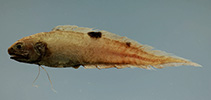
Teleostei (teleosts) >
Ophidiiformes (Cusk eels) >
Ophidiidae (Cusk-eels) > Neobythitinae
Etymology: Neobythites: Greek, neos = new + Greek, bythitis, -idos = it is at the bottom, sunken (Ref. 45335).
Eponymy: Professor Theodore Nicholas Gill (1837–1914) was an American ichthyologist, malacologist, mammologist and librarian, a zoologist at George Washington University and associated with the Smithsonian Institution for more than half a century. [...] (Ref. 128868), visit book page.
More on authors: Goode & Bean.
Environment: milieu / climate zone / depth range / distribution range
Ecology
Marine; demersal; depth range 60 - 230 m (Ref. 34024). Tropical
Western Atlantic: Gulf of Mexico.
Size / Weight / Age
Maturity: Lm ? range ? - ? cm
Max length : 14.9 cm SL male/unsexed; (Ref. 13608)
Common species (Ref. 34024) found to feed on crustaceans (Ref. 32505). Oviparous, with oval pelagic eggs floating in a gelatinous mass (Ref. 205).
Life cycle and mating behavior
Maturity | Reproduction | Spawning | Eggs | Fecundity | Larvae
Nielsen, J.G., D.M. Cohen, D.F. Markle and C.R. Robins, 1999. Ophidiiform fishes of the world (Order Ophidiiformes). An annotated and illustrated catalogue of pearlfishes, cusk-eels, brotulas and other ophidiiform fishes known to date. FAO Fish. Synop. 125(18):178p. Rome: FAO. (Ref. 34024)
IUCN Red List Status (Ref. 130435: Version 2025-2)
Threat to humans
Harmless
Human uses
Tools
Special reports
Download XML
Internet sources