-

- About this page
- Languages
- User feedbacks
- Citation
- Uploads
- Related species
-



Parateleopus indicus (Alcock, 1891)
Smallmouth jellynose
Upload your photos and videos
Pictures | Google image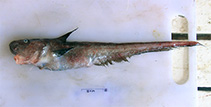 Parateleopus indicus
Picture by Viji, V.
Pictures | Google image
Picture by Viji, V.
Classification / Names Common names | Synonyms | Catalog of Fishes(genus, species) | ITIS | CoL | WoRMS | Cloffa
Teleostei (teleosts) > Ateleopodiformes (Jellynose fishes) > Ateleopodidae (Jellynose fishes)
Etymology: Parateleopus: Greek, para in the side of + Greek, tele = perfect (Ref. 45335).
More on author: Alcock.
Etymology: Parateleopus: Greek, para in the side of + Greek, tele = perfect (Ref. 45335).
More on author: Alcock.
Environment: milieu / climate zone / depth range / distribution range Ecology
Marine; bathydemersal; depth range 343 - 740 m (Ref. 127986). Deep-water
Distribution Territories | FAO areas | Ecosystems | Occurrences | Point map | Introductions | Faunafri
Indo-Pacific: Maldives and off Kenya, the Arabian Sea, Laccadive Sea and the Andaman Sea to Indonesia (Moluccas).
Size / Weight / Age
Short description Identification keys | Morphology | Morphometrics
Dorsal soft rays (total): 8 - 10; Vertebrae: 101 - 105. This species is distinguished by the following set of characters: mouth small, posterior end of gape vertical to near anterior nostril; gill membranes are united ventrally and attached to isthmus by soft tissue; sphenotic has vertically oblong crescent-shaped protrusion from behind the eye to postero-inferior region of orbit; pelvic fin stiff, relatively short, with the tip extending to point anywhere between base and anterior half of pectoral fin; wide pelvic bone (Ref. 127986).
Cross section: compressed.
Cross section: compressed.
Life cycle and mating behavior Maturity | Reproduction | Spawning | Eggs | Fecundity | Larvae
Main reference
Upload your references | References | Coordinator : Moore, Jon A. | Collaborators
Kaga, T., T. Iwamoto and S.S. Mishra, 2022. Redescription of Ateleopus indicus Alcock 1891, (Teleostei: Ateleopodiformes: Ateleopodidae), and its reassignment to the genus Parateleopus. Zootaxa 5092(2):176-190. (Ref. 127986)
IUCN Red List Status (Ref. 130435: Version 2025-2)
Least Concern (LC) ; Date assessed: 09 October 2018
CITES
Not Evaluated
Threat to humans
Harmless
Human uses
FAO - Publication: search | FishSource |
More information
Trophic ecology
Food items (preys)
Diet composition
Food consumption
Food rations
Predators
Food items (preys)
Diet composition
Food consumption
Food rations
Predators
Ecology
Ecology
Ecology
Population dynamics
Growth parameters
Max. ages / sizes
Length-weight rel.
Length-length rel.
Length-frequencies
Mass conversion
Recruitment
Abundance
Growth parameters
Max. ages / sizes
Length-weight rel.
Length-length rel.
Length-frequencies
Mass conversion
Recruitment
Abundance
Life cycle
Reproduction
Maturity
Maturity/Gills rel.
Fecundity
Spawning
Spawning aggregations
Eggs
Egg development
Larvae
Larval dynamics
Reproduction
Maturity
Maturity/Gills rel.
Fecundity
Spawning
Spawning aggregations
Eggs
Egg development
Larvae
Larval dynamics
Anatomy
Gill area
Brain
Otolith
Gill area
Brain
Otolith
Physiology
Body composition
Nutrients
Oxygen consumption
Swimming type
Swimming speed
Visual pigments
Fish sound
Diseases & Parasites
Toxicity (LC50s)
Body composition
Nutrients
Oxygen consumption
Swimming type
Swimming speed
Visual pigments
Fish sound
Diseases & Parasites
Toxicity (LC50s)
Genetics
Genome
Genetics
Heterozygosity
Heritability
Genetic Diversity
Genome
Genetics
Heterozygosity
Heritability
Genetic Diversity
Human related
Aquaculture systems
Aquaculture profiles
Strains
Ciguatera cases
Stamps, coins, misc.
Aquaculture systems
Aquaculture profiles
Strains
Ciguatera cases
Stamps, coins, misc.
Tools
Special reports
Download XML
Internet sources
AFORO (otoliths) | Aquatic Commons | BHL | Cloffa | Websites from users | Check FishWatcher | CISTI | Catalog of Fishes: genus, species | DiscoverLife | ECOTOX | FAO - Publication: search | Faunafri | Fishipedia | Fishtrace | GloBI | Google Books | Google Scholar | Google | IGFA World Record | OneZoom | Open Tree of Life | Otolith Atlas of Taiwan Fishes | PubMed | Reef Life Survey | Socotra Atlas | TreeBase | Tree of Life | Wikipedia: Go, Search |