>
Aulopiformes (Grinners) >
Omosudidae (Hammerjaws)
Etymology: Omosudis: Greek, omo = shoulder + Latin, sudis = esox, fish of the Rhine, cited by Plinius 9.15; it also means "stake" (Ref. 45335).
Eponymy: Rev. Richard Thomas Lowe (1802–1874) was a British botanist, ichthyologist and malacologist as well as being a clergyman. He graduated from Christ’s College, Cambridge (1825) and then took holy orders. He became a pastor in Madeira (1832), [...] (Ref. 128868), visit book page.
More on author: Günther.
Environment: milieu / climate zone / distribuzione batimetrica / distribution range
Ecologia
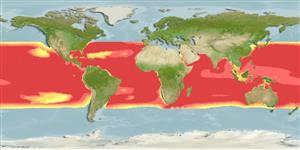
marino batipelagico; distribuzione batimetrica 0 - 4000 m (Ref. 38732), usually 100 - 1000 m (Ref. 7344). Deep-water; 40°N - 40°S
Worldwide in tropical and temperate waters. South China Sea and East China Sea (Ref.74511)
Size / Peso / Age
Maturità: Lm ? range ? - ? cm
Max length : 23.0 cm SL maschio/sesso non determinato; (Ref. 4475); common length : 20.0 cm NG maschio/sesso non determinato; (Ref. 5755)
Short description
Chiavi di identificazione | Morfologia | Morfometria
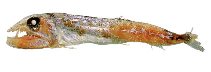
Spine dorsali (totale) : 0; Raggi dorsali molli (totale) : 9 - 12; Spine anali: 0; Raggi anali molli: 14 - 16. Brownish above, sides silvery, iridescent, with black peritoneum showing through (Ref. 7344).
Body shape (shape guide): elongated.
Meso- and bathypelagic at 700-1830 m (Ref. 58302). Probably swift swimmers, which can avoid nets, captured singly or in small groups (Ref. 6692). Carnivorous, feed on squids and pelagic fishes (Ref. 6692). Oviparous and are synchronous hermaphrodites (Ref. 84733).
Life cycle and mating behavior
Maturità | Riproduzione | Deposizione | Uova | Fecundity | Larve
Are synchronous hermaphrodites, gonads consist of clearly defined and well separated ovarian and testicular regions with no indication of sequential maturation of the sex products (Ref. 84733). Also Ref. 103751.
Post, A., 1984. Omosudidae. p. 496-497. In P.J.P. Whitehead, M.-L. Bauchot, J.-C. Hureau, J. Nielsen and E. Tortonese (eds.) Fishes of the north-eastern Atlantic and the Mediterranean. UNESCO, Paris. Vol. 1. (Ref. 6692)
IUCN Red List Status (Ref. 130435: Version 2025-1)
Threat to humans
Harmless
Human uses
Pesca: di nessun interesse
Strumenti
Special reports
Download XML
Fonti Internet
Estimates based on models
Preferred temperature (Fonte Biblio.
123201): 4.8 - 21.3, mean 10.5 °C (based on 2379 cells).
Phylogenetic diversity index (Fonte Biblio.
82804): PD
50 = 1.5000 [Uniqueness, from 0.5 = low to 2.0 = high].
Bayesian length-weight: a=0.00389 (0.00180 - 0.00842), b=3.12 (2.94 - 3.30), in cm total length, based on all LWR estimates for this body shape (Ref.
93245).
Trophic level (Fonte Biblio.
69278): 4.3 ±0.64 se; based on food items.
Resilienza (Fonte Biblio.
120179): Medio, tempo minimo di raddoppiamento della popolazione 1.4 - 4.4 anni (Assuming tm=2-4).
Fishing Vulnerability (Ref.
59153): Low vulnerability (18 of 100).
🛈