Teleostei (teleosts) >
Blenniiformes (Blennies) >
Blenniidae (Combtooth blennies) > Salariinae
Etymology: Cirripectes: Latin, cirrus = curl fringe + Greek, pektos, -e, -on = made of several parts solidly united (Ref. 45335); fuscoguttatus: Specific epithet 'fuscus' meaning dusky or dark and 'guttatus' meaning spotted, referring to the dark brown spots on head and body.
More on authors: Strasburg & Schultz.
Environment: milieu / climate zone / depth range / distribution range
Ecology
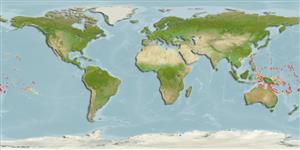
Marine; reef-associated; depth range 0 - 8 m (Ref. 529). Tropical; 27°N - 25°S
Pacific Ocean: southern Taiwan to Tuamoto Islands, south to Tonga; throughout Micronesia.
Length at first maturity / Size / Weight / Age
Maturity: Lm ?, range 6 - ? cm
Max length : 10.6 cm SL male/unsexed; (Ref. 529)
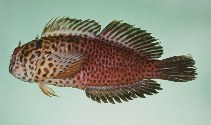
Dorsal spines (total): 12; Dorsal soft rays (total): 13 - 15; Anal spines: 2; Anal soft rays: 14 - 16; Vertebrae: 30. Diagnosis: Dorsal fin XII, 14, membrane attached to caudal fin, with deep notch above last spine, first spine almost same or slightly higher than second; anal fin II, 15; pectoral rays 15; pelvic fin I, 4; caudal fin procurrent rays 11-14. Vertebrae 10 + 20. LL, without scales and scalelike flaps; LL tubes 0-3 (sometimes up to 5), canal ends below 13th dorsal spine to caudal-fin base. Upper lip crenulae 40-55. Gill rakers 22-32. Cephalic sensory pore system complex. Cirri: supraorbital 18-42 (usually 20-37); nasal 7-32 (usually 11-27); nuchal 47-66 (usually 50-60), in 4 groups with 2 or more sometimes connected basally by a frenum, dorsalmost groups usually meet or overlap at midpoint on nape, ventralmost group on each side borne on broadly expanded flap. Head with dark brown spots on pale background; orangish red iris; yellow pelvic fins; pectoral fins spotted on proximal half. (Ref. 529).
Body shape (shape guide): fusiform / normal; Cross section: oval.
Facultative air-breathing in the genus (Ref. 126274); Typically found in the surge zone of coral reefs from 0-8 m deep (Ref. 529). Oviparous. Eggs are demersal and adhesive (Ref. 205), and are attached to the substrate via a filamentous, adhesive pad or pedestal (Ref. 94114). Larvae are planktonic, often found in shallow, coastal waters (Ref. 94114).
Life cycle and mating behavior
Maturity | Reproduction | Spawning | Eggs | Fecundity | Larvae
Oviparous, distinct pairing (Ref. 205). Urogenital orifice of male genital papilla located basally between 2 widely separated slender filaments on a fleshy swelling behind anus; testes bulbous with length equal to its width (Ref. 529).
Williams, J.T., 1988. Revision and phylogenetic relationships of the blenniid fish genus Cirripectes. Indo-Pac. Fish. (17):78 p. (Ref. 529)
IUCN Red List Status (Ref. 130435: Version 2025-2)
Threat to humans
Harmless
Human uses
Fisheries: of no interest
Tools
Special reports
Download XML
Internet sources