>
Gobiiformes (Gobies) >
Gobiidae (Gobies) > Gobiinae
Etymology: Lythrypnus: Greek, lythros, -on = blood + Greek, hypnos = sleep (Ref. 45335).
Eponymy: William Healey Dall (1845–1927) was an America naturalist. [...] (Ref. 128868), visit book page.
More on author: Gilbert.
Environment: milieu / climate zone / rango de profundidad / distribution range
Ecología
marino demersal; rango de profundidad 0 - 76 m (Ref. 2850). Subtropical; 18°C - 22°C (Ref. 27115)
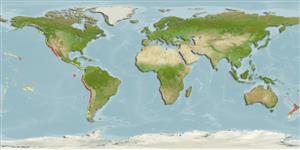
Eastern Pacific: Gulf of California to Ecuador and north of Perú.
Tamaño / Peso / Age
Madurez: Lm ? range ? - ? cm
Max length : 6.4 cm TL macho / no sexado; (Ref. 2850)
Short description
Claves de identificación | Morfología | Morfometría
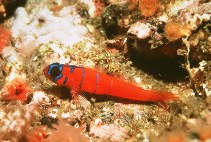
Found usually in open rocky areas but retreats to crevices or holes or hides among spines of sea urchins when threatened. Territorial. Sits on exposed rock surfaces near a hole or crevice. Feeds mainly on small crustaceans. Oviparous (Ref. 56079). Males guard the eggs which are found attached to the walls of brood chamber (Ref. 56079). Female deposits oblong eggs in empty shells; male guards them. Often found with Lythrypnus zebra.
Life cycle and mating behavior
Madurez | Reproducción | Puesta | Huevos | Fecundidad | Larva
Oviparous, demersal spawner (Ref. 101194). Both male and female spawn with many individuals in small contiguous territories (Ref. 240). Males guard the eggs which are found attached to the walls of brood chamber (Ref. 56079). Simultaneous hermaphrodite with varying allocation of reproductive tissue to male and female function (Ref. 31569). Bi-directional sex change has been confirmed for this species (Ref. 103751).
Eschmeyer, W.N., E.S. Herald and H. Hammann, 1983. A field guide to Pacific coast fishes of North America. Boston (MA, USA): Houghton Mifflin Company. xii+336 p. (Ref. 2850)
IUCN Red List Status (Ref. 130435: Version 2025-1)
Threat to humans
Harmless
Human uses
Pesquerías: comercial; Acuario: Comercial
Herramientas
Special reports
Download XML
Fuentes de Internet
Estimates based on models
Preferred temperature (Referencia
123201): 15.8 - 25.9, mean 21.2 °C (based on 54 cells).
Phylogenetic diversity index (Referencia
82804): PD
50 = 0.5000 [Uniqueness, from 0.5 = low to 2.0 = high].
Bayesian length-weight: a=0.00955 (0.00526 - 0.01733), b=3.00 (2.84 - 3.16), in cm total length, based on LWR estimates for this species & (Sub)family-body (Ref.
93245).
Nivel trófico (Referencia
69278): 3.2 ±0.33 se; based on food items.
Resiliencia (Referencia
120179): Alto, población duplicada en un tiempo mínimo inferior a 15 meses (Preliminary K or Fecundity.).
Fishing Vulnerability (Ref.
59153): Low vulnerability (10 of 100).
🛈
Nutrients (Ref.
124155): Calcium = 328 [138, 780] mg/100g; Iron = 1.84 [0.97, 3.82] mg/100g; Protein = 18.2 [16.3, 19.9] %; Omega3 = 0.429 [0.186, 0.850] g/100g; Selenium = 20.5 [8.9, 44.4] μg/100g; VitaminA = 21.3 [5.8, 73.2] μg/100g; Zinc = 1.56 [1.00, 2.41] mg/100g (wet weight);