Teleostei (teleosts) >
Eupercaria/misc (Various families in series Eupercaria) >
Labridae (Wrasses) > Scarinae
Etymology: Cryptotomus: Greek, kryptos = hidden + Greek, tomos, = section, cut (Ref. 45335).
More on author: Cope.
Environment: milieu / climate zone / depth range / distribution range
Ecology
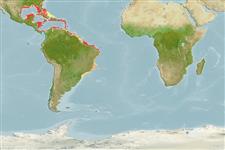
Marine; reef-associated; depth range ? - 60 m (Ref. 13628). Tropical; 32°N - 33°S
Western Atlantic: Bermuda, southern Florida (USA), and Bahamas to Brazil (Ref. 7251). Possibly in Ascension I. (Ref. 98447).
Size / Weight / Age
Maturity: Lm ? range ? - ? cm
Max length : 13.0 cm TL male/unsexed; (Ref. 7251); common length : 10.0 cm TL male/unsexed; (Ref. 5217)
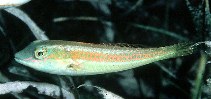
Dorsal spines (total): 9; Dorsal soft rays (total): 10; Anal spines: 2; Anal soft rays: 9. Jaw teeth fused only at bases. Anterior nostril without membranous flap (Ref. 26938). Male color, olivaceous on the back with small pink dots; a salmon stripe along the side with a row of green dots; body below stripe light green with some salmon markings on scales (Ref. 13442).
Body shape (shape guide): fusiform / normal.
Inhabits seagrass beds and weedy areas with sand (Ref. 9710). Feeds on seagrasses (Ref. 9710). Buries in the sand to sleep in a mucus tube (Ref. 9710). Protogynous hermaphrodite (Ref. 55367).
Life cycle and mating behavior
Maturity | Reproduction | Spawning | Eggs | Fecundity | Larvae
Forms leks during breeding (Ref. 55367). A monandric species (Ref. 55367). Length at sex change = 5.75 cm TL (Ref. 55367).
Robins, C.R. and G.C. Ray, 1986. A field guide to Atlantic coast fishes of North America. Houghton Mifflin Company, Boston, U.S.A. 354 p. (Ref. 7251)
IUCN Red List Status (Ref. 130435: Version 2025-2)
Threat to humans
Harmless
Human uses
Fisheries: commercial; aquarium: commercial
Tools
Special reports
Download XML
Internet sources