Teleostei (teleosts) >
Acanthuriformes (Surgeonfishes) >
Pomacanthidae (Angelfishes)
Etymology: Centropyge: Greek, kentron = sting + Greek, pyge = tail (Ref. 45335).
Environment: milieu / climate zone / depth range / distribution range
Ecology
Marine; reef-associated; non-migratory; depth range 5 - 80 m (Ref. 9626), usually 5 - 30 m (Ref. 9626). Subtropical; 35°N - 10°N
Western Atlantic: Bermuda and Florida, USA to French Guiana, including the Gulf of Mexico and the Caribbean Sea.
Size / Weight / Age
Maturity: Lm ? range ? - ? cm
Max length : 8.0 cm TL male/unsexed; (Ref. 9710)
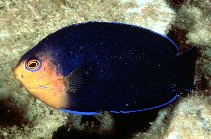
Dorsal spines (total): 14 - 15; Dorsal soft rays (total): 15 - 16; Anal spines: 3; Anal soft rays: 17. Deep blue, the head and chest orange-yellow; a narrow blue ring around eye; a small dark blue smudge just behind corner of mouth; pectoral fins pale yellowish; other fins deep blue with pale blue margins (Ref. 13442).
Body shape (shape guide): short and / or deep; Cross section: compressed.
Normally occurs in rubble areas. Feeds on various types of algae. Oviparous (Ref. 205), monogamous (Ref. 52884). Retreats into holes when frightened (Ref. 9710). Has been reared in captivity (Ref. 35408).
Life cycle and mating behavior
Maturity | Reproduction | Spawning | Eggs | Fecundity | Larvae
Oviparous, distinct pairing (Ref. 240). Monogamous mating is observed as both facultative and social (Ref. 52884).
Allen, G.R., 1985. Butterfly and angelfishes of the world. Vol. 2. 3rd edit. in English. Mergus Publishers, Melle, Germany. (Ref. 4858)
IUCN Red List Status (Ref. 130435: Version 2025-2)
Threat to humans
Harmless
Human uses
Fisheries: commercial; aquarium: commercial
Tools
Special reports
Download XML
Internet sources