>
Perciformes/Serranoidei (Groupers) >
Serranidae (Sea basses: groupers and fairy basslets)
Etymology: Serranus: Latin, serran, serranus, saw and a fish of genus Serranus (Ref. 45335).
Eponymy: Albertus Hutchinson Baldwin (1865–1935) was an American artist. [...] (Ref. 128868), visit book page.
More on authors: Evermann & Marsh.
Environment: milieu / climate zone / Tiefenbereich / distribution range
Ökologie
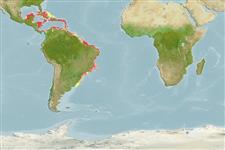
seewasser riff-verbunden; tiefenbereich 1 - 80 m (Ref. 9710). Tropical; 33°N - 36°S, 99°W - 28°W
Western Atlantic: southern Florida, USA and Bahamas to southeastern Brazil (Ref. 57756).
Size / Gewicht / Alter
Geschlechtsreife: Lm ? range ? - ? cm
Max length : 12.0 cm TL Männchen/unbestimmt; (Ref. 5217)
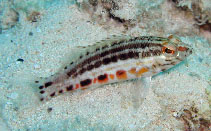
Rückenflossenstacheln (insgesamt) : 10; Rückenflossenweichstrahlen (insgesamt) : 11 - 13. Lower side has4 square black blotches, each with red bar (yellowish in deep water) below it.
Body shape (shape guide): fusiform / normal.
Inhabits rocky and weedy areas. Synchronously hermaphroditic. Feeds on caridean shrimp and small fish (Ref. 5521).
Life cycle and mating behavior
Geschlechtsreife | Fortpflanzung | Ablaichen | Eier | Fecundity | Larven
Pelagic spawner. This species exhibits a combination of simultaneous and sequential hermaphroditism. Smaller individuals within a social group are simultaneous hermaphrodites, while the largest often lose female function and reproduce exclusively as a male (Ref. 103751).
Böhlke, J.E. and C.C.G. Chaplin, 1993. Fishes of the Bahamas and adjacent tropical waters. 2nd edition. University of Texas Press, Austin. (Ref. 5521)
IUCN Rote Liste Status (Ref. 130435: Version 2025-1)
Bedrohung für Menschen
Harmless
Nutzung durch Menschen
Fischereien: kommerziell; Aquarium: Kommerziell
Tools
Zusatzinformationen
Download XML
Internet Quellen
Estimates based on models
Preferred temperature (Ref.
123201): 22.4 - 28, mean 26.9 °C (based on 330 cells).
Phylogenetic diversity index (Ref.
82804): PD
50 = 0.5000 [Uniqueness, from 0.5 = low to 2.0 = high].
Bayesian length-weight: a=0.01096 (0.00518 - 0.02319), b=3.05 (2.88 - 3.22), in cm total length, based on LWR estimates for this Genus-body shape (Ref.
93245).
Trophic level (Ref.
69278): 4.1 ±0.70 se; based on food items.
Widerstandsfähigkeit (Ref.
120179): hoch, Verdopplung der Population dauert weniger als 15 Monate. (Preliminary K or Fecundity.).
Fishing Vulnerability (Ref.
59153): Low vulnerability (10 of 100).
🛈
Nutrients (Ref.
124155): Calcium = 91.6 [47.8, 182.2] mg/100g; Iron = 0.741 [0.377, 1.306] mg/100g; Protein = 18.5 [16.6, 20.2] %; Omega3 = 0.202 [0.122, 0.334] g/100g; Selenium = 28.4 [14.9, 55.0] μg/100g; VitaminA = 151 [47, 528] μg/100g; Zinc = 1.45 [0.96, 2.14] mg/100g (wet weight);