Environment: milieu / climate zone / kisaran kedalaman / distribution range
Ekologi
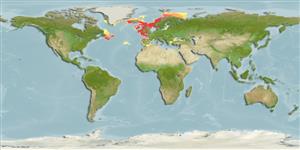
laut dasar (demersal); oceanodromus (Ref. 51243); kisaran kedalaman 100 - 1000 m (Ref. 35388), usually 100 - 400 m (Ref. 35388). Temperate; 75°N - 35°N, 55°W - 44°E (Ref. 54595)
Northwest Atlantic: off southern Greenland and Canada. Northeast Atlantic: Barents Sea and Iceland to Morocco. Mediterranean Sea: northwestern Mediterranean only.
Length at first maturity / Size / Weight / umur
Kematangan: Lm 92.5, range 90 - 100 cm
Max length : 200 cm TL jantan/; (Ref. 1371); common length : 106 cm TL jantan/; (Ref. 1371); Berat maksimum terpublikasi: 45.0 kg (Ref. 35388); Umur maksimum dilaporkan: 25 Tahun (Ref. 35388)
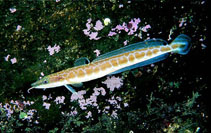
Duri punggung (Keseluruhan (total)) : 0; duri punggung lunak (Keseluruhan (total)) : 75 - 83; Sirip dubur lunak: 58 - 64; vertebrata, bertulang belakang: 63 - 65. Upper jaw projecting beyond lower one. Color is reddish brown dorsally, grading to white ventrally. The posterior areas of the vertical fins dark with pale margins. The sides distinctly marbled (Ref. 232). Barbel is present in the chin, longer than the diameter of the eye. Black spot in the rear end of the first dorsal fin. Caudal peduncle stout compared to blue ling (Ref. 35388).
Body shape (shape guide): elongated; Cross section: circular.
Occurs mainly on rocky bottoms in fairly deep water (Ref. 9988). Found more commonly from 100 to 400 m. Feeds on fish (cod, herring, flatfish), lobsters, cephalopods and starfishes. Principal spawning areas are Biscay, slopes west of the British Isles and off the Faeroes and southern Iceland (Ref. 35388). Marketed fresh, dried or salted and frozen; eaten steamed, fried, broiled and baked (Ref. 9988).
Major spawning grounds are located at 200 m depth from the Bay of Biscay to the Gulf of Norway at 100 to 300 m off southern Iceland, and at 50 to 300 m in the Mediterranean Sea. Fecundity may reach 20 to 60 million eggs per female (Ref. 1371).
Cohen, D.M., T. Inada, T. Iwamoto and N. Scialabba, 1990. FAO species catalogue. Vol. 10. Gadiform fishes of the world (Order Gadiformes). An annotated and illustrated catalogue of cods, hakes, grenadiers and other gadiform fishes known to date. FAO Fish. Synop. 125(10). Rome: FAO. 442 p. (Ref. 1371)
Status IUCN Red List (Ref. 130435: Version 2025-1)
ancaman kepada manusia
Harmless
penggunaan manusia
Perikanan: bernilai komersial tinggi; Ikan buruan: ya
Alat, peralatan
laporan khas
muat turun XML
Sumber internet
Estimates based on models
Preferred temperature (Acuan
123201): 4.6 - 11.3, mean 7.7 °C (based on 438 cells).
Phylogenetic diversity index (Acuan
82804): PD
50 = 0.6562 [Uniqueness, from 0.5 = low to 2.0 = high].
Bayesian length-weight: a=0.00389 (0.00241 - 0.00628), b=3.06 (2.92 - 3.20), in cm total length, based on LWR estimates for this species & (Sub)family-body (Ref.
93245).
Trophic level (Acuan
69278): 4.4 ±0.2 se; based on diet studies.
Daya lenting (Acuan
120179): sedang, Waktu penggandaan populasi minimum 1.4 - 4.4 tahun (K=0.12; tm=5-6; tmax=25; Fec=60 million).
Prior r = 0.55, 95% CL = 0.36 - 0.82, Based on 9 full stock assessments.
Fishing Vulnerability (Ref.
59153): Very high vulnerability (77 of 100).
🛈
Climate Vulnerability (Ref.
125649): Moderate vulnerability (38 of 100).
🛈
Nutrients (Ref.
124155): Calcium = 15.2 [7.4, 33.3] mg/100g; Iron = 0.278 [0.140, 0.600] mg/100g; Protein = 17.7 [15.9, 19.4] %; Omega3 = 0.368 [0.197, 0.685] g/100g; Selenium = 32.5 [16.9, 66.3] μg/100g; VitaminA = 8.35 [2.10, 31.25] μg/100g; Zinc = 0.28 [0.18, 0.44] mg/100g (wet weight);