Teleostei (teleosts) >
Cypriniformes (Carps) >
Nemacheilidae (Brook loaches)
Etymology: Schistura: Greek, schizein = to divide + Greek, oura = tail; an allusion to forked caudal fins (Ref. 45335); reidi: Named for E.D. Reid.
Eponymy: Earl Desmond Reid (1885–1960) was Assistant Curator, Division of Fishes at the Smithsonian (United States National Museum, USNM) where Isaac Ginsburg also worked. [...] (Ref. 128868), visit book page.
More on author: Smith.
Environment: milieu / climate zone / depth range / distribution range
Ecology
Freshwater; benthopelagic. Tropical
Asia: known only from the Salween basin in Mae Hong Son Province, Thailand.
Size / Weight / Age
Maturity: Lm ? range ? - ? cm
Max length : 8.9 cm SL male/unsexed; (Ref. 39226)
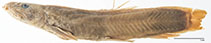
Dorsal soft rays (total): 12; Anal soft rays: 8. A member of the group of species with complete or nearly complete lateral line, 8 1/2 branched dorsal rays, 9+8 branched caudal rays and no sexual dimorphism. Black basal caudal bar usually dissociated into a vertically elongated blotch at extremity of lateral line and a triangular blotch at upper extremity of caudal fin base; 9-14 bars on body; black inner axial stripe usually present (Ref. 39226).
Body shape (shape guide): elongated.
Most commonly found in swiftly flowing waters. A female measuring 6.13 cm SL contained ripe ovulae 1.7 mm in diameter (Ref. 39226).
Life cycle and mating behavior
Maturity | Reproduction | Spawning | Eggs | Fecundity | Larvae
Kottelat, M., 1990. Indochinese nemacheilines. A revision of nemacheiline loaches (Pisces: Cypriniformes) of Thailand, Burma, Laos, Cambodia and southern Viet Nam. Verlag Dr. Friedrich Pfeil, München, Germany. 262 p. (Ref. 39226)
IUCN Red List Status (Ref. 130435: Version 2025-2)
Threat to humans
Harmless
Human uses
Tools
Special reports
Download XML
Internet sources