Teleostei (teleosts) >
Aulopiformes (Grinners) >
Paralepididae (Barracudinas)
Etymology: Lestrolepis: Greek, lestris, -idos = bandit + Greek,lepis = scale (Ref. 45335).
More on author: Tanaka.
Environment: milieu / climate zone / depth range / distribution range
Ecology
Marine; pelagic-oceanic. Subtropical
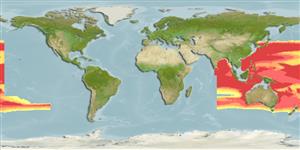
Western Pacific: widespread; with confirmed records from Japan, Taiwan, the Philippines, nw Australia and the South China Sea.
Size / Weight / Age
Maturity: Lm ? range ? - ? cm
Max length : 22.2 cm TL male/unsexed; (Ref. 121637); max. reported age: 4 years (Ref. 50621)
Short description
Identification keys | Morphology | Morphometrics
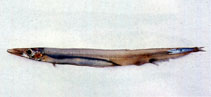
Dorsal soft rays (total): 9; Anal soft rays: 36 - 40; Vertebrae: 82 - 88. This moderately elongate species is distinguished by the following: body depth 13-16 times in SL; dorsal-fin origin clearly before midline of horizontal distance between origins of pelvic (ventral) and anal fins (V-A), origins of pelvic and dorsal fins (V–D) 32.5-43.1% V–A; A 36-40; vertebrae: prehaemal 30-32, prepelvic 30-33, predorsal 36-40, preanal 48-51, caudal 52-58; and total 82-88; total lateral-line scales 66-72; with a narrow band of black chromatophores along lower portion of abdominal ridge (Ref. 121637).
Cross section: compressed.
Mesopelagic species (Ref. 7300, 75154). Feeds on small fishes rather than shrimps (Ref. 121637).
Synchronous hermaphrodite (Ref. 84976).
Ho, H.-C., S.-Y. Tsai and H.-H. Li, 2019. The barracudina genera Lestidium and Lestrolepis of Taiwan, with descriptions of two new species (Aulopiformes: Paralepididae). Zootaxa 4702(1):114-139. (Ref. 121637)
IUCN Red List Status (Ref. 130435: Version 2025-2)
Threat to humans
Harmless
Human uses
Tools
Special reports
Download XML
Internet sources