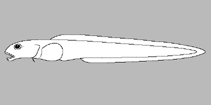
Teleostei (teleosts) >
Perciformes/Zoarcoidei (Eelpouts and pricklebacks) >
Zoarcidae (Eelpouts) > Gymnelinae
Etymology: Krusensterniella: Named after the Russian navigator explorer, Admiral I.F. Krusenstern, who led the first Russian circumnavigation (1803– 1806) and visited that part of the Sea of Okhotsk where the type species was found. Of the two Russian-language names 'krusensterniella' (Taranets, 1937) and 'kruzenshternia' (Sheiko and Fedorov, 2000)—the first one has come into scientific use (Ref. 130195); notabilis: Name from Latin 'notabilis' meaning notable.
Environment: milieu / climate zone / depth range / distribution range
Ecology
Marine; demersal; depth range 24 - 305 m (Ref. 130195). Temperate
Northwest Pacific: Sea of Okhotsk, the Kuril Islands, and the Tatar Strait of the Sea of Japan.
Size / Weight / Age
Maturity: Lm ? range ? - ? cm
Max length : 18.9 cm TL male/unsexed; (Ref. 130195)
The life history of this species has not been studied, but it may serve as an additionary food item for demersal predators, where one specimen was found in the stomach of the stingray Bathyraja sp. caught in the area of Simushir Island (Ref. 130195). Minimum depth (24 m) from Ref. 50550.
Life cycle and mating behavior
Maturity | Reproduction | Spawning | Eggs | Fecundity | Larvae
Chernova, N.V., 2022. Review of prickled eelpouts of genus Krusensterniella (Zoarcidae) describing three new species from the far-eastern seas. J. Ichthyol. 62(2):153-172. (Ref. 130195)
IUCN Red List Status (Ref. 130435: Version 2025-2)
Threat to humans
Harmless
Human uses
Fisheries: of no interest
Tools
Special reports
Download XML
Internet sources