Teleostei (teleosts) >
Gobiiformes (Gobies) >
Gobiidae (Gobies) > Gobiinae
Etymology: Acentrogobius: Greek, a = without + Greek, kentron = sting + Latin gobius = gudgeon (Ref. 45335).
More on author: Bleeker.
Environment: milieu / climate zone / depth range / distribution range
Ecology
Marine; freshwater; brackish; reef-associated; amphidromous (Ref. 59012). Tropical
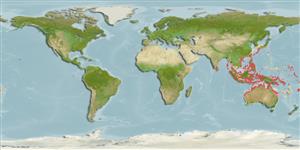
Indo-Pacific: from the Eastern Indian Ocean: Indonesia (Ref. 7050) and western Australia (Ref. 49596) to Western Pacific: Japan, Philippines and Indonesia.
Size / Weight / Age
Maturity: Lm ? range ? - ? cm
Max length : 12.5 cm TL male/unsexed; (Ref. 7050)
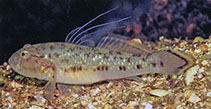
Dorsal spines (total): 6 - 7; Dorsal soft rays (total): 10; Anal spines: 1; Anal soft rays: 8. Characterized by pale greyish to light brown body color with brown mottling on back; midside with horizontal row of five brown blotches or clusters of smaller spots; caudal fin with scattered iridescent green flecks and submarginal dark band; first dorsal fin spines elongate and filamentous in male; rounded caudal fin, equal or slightly longer than head; longitudinal scale series 32; predorsal scales behind eyes; fully scaled opercle; upper half of cheek scaled; depth of body 3.5-3.8 in SL (Ref. 90102).
Body shape (shape guide): elongated.
Inhabits mud bottoms of estuaries, marine lakes and occasionally in the vicinity of reefs (Ref. 90102). Common in marine lakes (Ref. 37816).
Life cycle and mating behavior
Maturity | Reproduction | Spawning | Eggs | Fecundity | Larvae
Masuda, H., K. Amaoka, C. Araga, T. Uyeno and T. Yoshino, 1984. The fishes of the Japanese Archipelago. Vol. 1. Tokai University Press, Tokyo, Japan. 437 p. (text). (Ref. 559)
IUCN Red List Status (Ref. 130435: Version 2025-2)
Threat to humans
Harmless
Human uses
Tools
Special reports
Download XML
Internet sources